
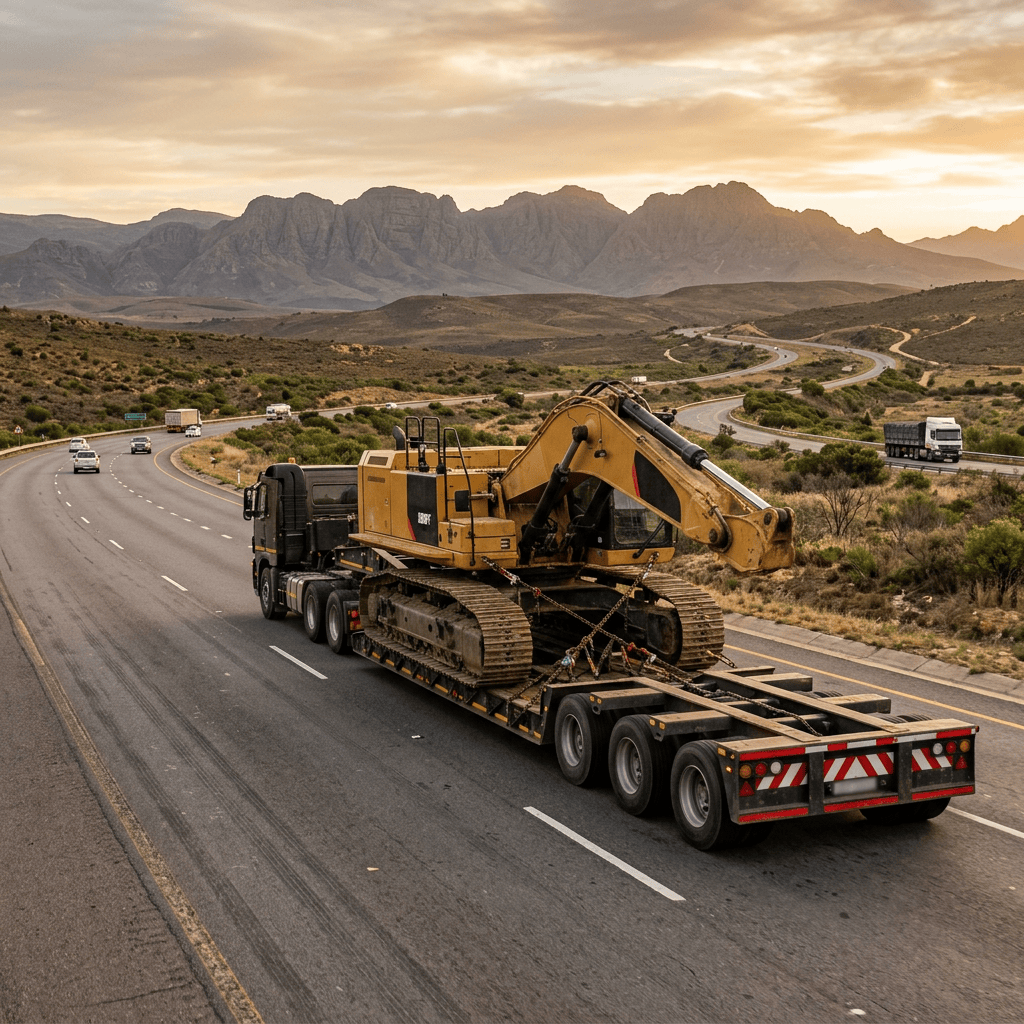
A low bed trailer is a heavy-duty trailer with a deck set close to the ground, built to carry tall, heavy or awkward machinery such as excavators, graders, cranes and transformers. In South Africa, low bed hire is usually quoted per trip or per day, with the price depending on the load’s weight and size, the distance, the trailer type and whether escorts or permits are needed. If the loaded combination exceeds legal dimensions or mass, it becomes an abnormal load and needs a permit.
Low beds are the workhorses of construction, mining, plant hire and heavy industry. If you have a machine that cannot be driven on the road, or that is simply too big for a normal truck, a low bed is usually the answer. Hiring one well, though, means understanding what the trailer can carry, what the law requires and what affects the final cost.
What a low bed trailer does
The defining feature of a low bed is its low deck height. This allows tall equipment to be loaded while keeping the overall height of the loaded combination within the legal limit. It also lowers the centre of gravity, which improves stability with heavy loads. Most low beds load via a hydraulic or mechanical ramp system at the rear, or by driving the machine up on ramps, and some have detachable gooseneck designs that allow the machine to be driven straight on.
Common uses
- Earthmoving equipment. Excavators, bulldozers, graders and wheel loaders moved between sites.
- Mining machinery. Drill rigs, haul-truck components and processing equipment.
- Cranes and lifting equipment. Mobile cranes and crane components.
- Agricultural machinery. Combine harvesters, large tractors and irrigation equipment.
- Industrial plant. Transformers, generators, press machines and prefabricated units.
- Vehicles and buses. Non-running or oversized vehicles that cannot be driven or towed.
Types of low bed
Low bed trailers come in several configurations, and the right one depends on the load.
- Standard low bed (semi-trailer). A common choice for a wide range of machinery, with a fixed length and a set number of axles.
- Extendable low bed. The deck lengthens to carry long loads such as wind turbine blades, girders or pipe sections.
- Step-deck or drop-deck trailers. A raised front section over the truck, and a lower rear section for tall loads.
- Multi-axle low beds. Additional axle lines spread the weight of very heavy loads across more tyres, which is essential to stay within axle mass limits.
- Modular or hydraulic platform trailers. Specialised units for extremely heavy or awkward loads, such as large transformers or industrial modules.
Confirm the trailer’s rated capacity, deck length and width, and number of axles before you agree to a hire. The trailer must suit the load’s weight and dimensions, and its weight distribution once loaded.
What affects the price
Low bed hire is rarely charged by a simple daily rate, so requests for a quote need good detail. The main factors are:
- Load weight and dimensions. Heavier or wider loads need larger trailers and more axle lines.
- Distance and route. Long trips cost more, as do routes with tolls or restricted roads.
- Trailer type. Extendable and multi-axle units usually cost more than a standard low bed.
- Permits and escorts. If the load is abnormal, permit fees, escort vehicles and route surveys add to the price.
- Loading and offloading. Time spent waiting at sites, or the need for cranes or ramps, can add charges.
- Return trips. If the trailer returns empty, that cost is usually priced in.
- Urgency. Short-notice jobs typically carry a premium.
Because so many variables are involved, treat any published rate as a guide. A reliable supplier will ask about your load in detail before quoting.
The legal points you cannot skip
In South Africa, the National Road Traffic Regulations set legal limits on vehicle dimensions and mass. In general, a vehicle or combination is considered abnormal if it exceeds limits such as a width of 2.6 m, a height of 4.3 m, or a length of 18.5 m for an articulated combination, or if it exceeds axle or total mass limits. Where a load and trailer combination cannot fit within those limits and the load cannot reasonably be dismantled, an exemption permit is required. Our guide to abnormal load transport in South Africa explains permits, escorts and costs in detail.
Even a load that is legal in overall dimensions can breach axle mass limits if it is badly positioned on the deck. This is one of the most common reasons operators are stopped. A competent operator will plan the load position and axle weights before departure.
Questions to ask before hiring
- What is the trailer’s rated capacity and deck size? Match these to your machine’s weight, width, length and height.
- Will the loaded combination be within legal limits? If not, who applies for the permit and how long will it take?
- Are escort vehicles required? Ask who provides them and how they are priced.
- Who loads and secures the cargo? Confirm the operator’s method of chaining, strapping and blocking the load.
- What insurance is in place? Ask about cover for the trailer, the prime mover and your equipment while it is in transit.
- Is the driver experienced? Low bed driving is a specialist skill, and the driver should hold the correct licence code and permit.
- What happens in a breakdown? Ask how quickly a replacement can be arranged.
Preparing your equipment
You can reduce cost and risk by preparing well. Clean the machine so that mud and debris do not add weight or create hazards, and check that hydraulic components are secured. Provide the operator with accurate weights and dimensions, including attachments, and confirm that the site has a safe, level place to load and offload. Ask whether the machine has designated lifting and tie-down points.
Choosing a supplier
Check that the company is properly registered and insured, ask to see the trailer and prime mover, and ask for references from similar jobs. If you also need general vehicles for the same project, the truck rental page and our regional guide to truck rental in Durban give an overview of how rental categories and pricing typically work.
Frequently asked questions
How much does low bed hire cost in South Africa?
There is no standard rate. Pricing depends on load, distance, trailer type and permits, so request a written quote for your specific job.
Do I need a permit to move a machine on a low bed?
Only if the loaded combination exceeds legal dimensions or mass. Many machines can be moved within legal limits.
Can a low bed carry two machines at once?
Sometimes, provided the combined weight and dimensions stay within limits. Confirm this with the operator.
Who is responsible for damage during transport?
Responsibility depends on the contract and insurance. Clarify this in writing before the job begins.
How far ahead should I book?
Book early for heavy or abnormal loads, since permits and specialised trailers can take time to arrange.


Leave a comment