
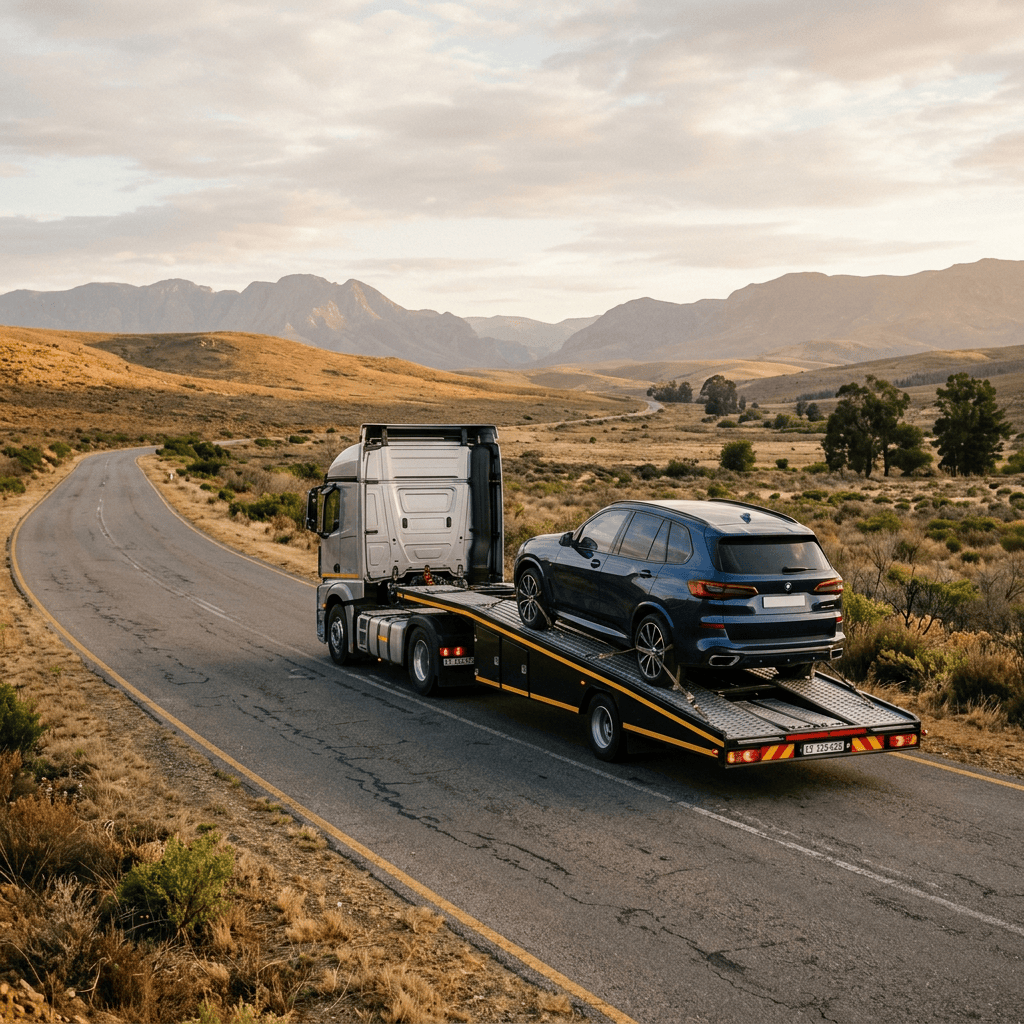
A single-car carrier moves one vehicle at a time, usually on a rollback, tilt-bed or small trailer. A multi-car carrier trailer moves several vehicles at once on stacked decks. The real difference is volume, cost per vehicle and flexibility: single-car units suit one-off, urgent or non-running vehicles, while a multi car carrier trailer in South Africa is the standard choice when several vehicles need to travel the same route.
For one car across town, the choice is simple. It gets more interesting at five, ten or fifty vehicles, when trip economics start to decide the outcome.
What Is a Single-Car Carrier?
A single-car carrier is any transporter built to haul one vehicle. The most common forms are the rollback (slide-back) truck, the flatbed tow truck, and the open or enclosed single-vehicle trailer pulled by a bakkie or light truck. The vehicle rides on one flat deck that tilts or slides down to ground level, so it can be driven or winched on.
Because the bed lowers so close to the ground, single-car carriers cope well with vehicles that cannot move under their own power: accident-damaged cars, breakdowns, project builds and low-clearance sports cars. They can also load almost anywhere a truck can reach, which makes them the usual choice for home collections and roadside recoveries.
What Is a Multi-Car Carrier Trailer?
A multi-car carrier is a purpose-built transporter with an upper and lower deck, often with hydraulic ramps, designed to haul several vehicles in one trip. In South Africa these usually run as articulated semi-trailers behind a truck-tractor, or as a rigid truck paired with a drawbar trailer. Hydraulic decks tilt and lift so vehicles can be driven onto the top level and secured at an angle that keeps the whole load within legal height limits.
Several local manufacturers build these in different configurations. This overview of Afrit trailers, features and pricing gives a sense of what is on the market and how trailer choice affects payload.
Single-Car vs Multi-Car Carrier: Side-by-Side Comparison
| Feature | Single-car carrier | Multi-car carrier trailer |
|---|---|---|
| Vehicles per trip | One | Typically six to ten, depending on configuration |
| Best for | Once-off moves, non-runners, urgent jobs | Dealer stock, fleets, auction lots, long routes |
| Cost per vehicle | Highest on long routes | Lowest on long routes, as trip costs are shared |
| Loading access | Almost anywhere a truck can reach | Needs a level yard or forecourt with room to manoeuvre |
| Non-running vehicles | Handled easily with a winch | Possible with a winch, but limited by deck layout |
| Scheduling | On demand, often same-day | Planned around route and load consolidation |
How Many Vehicles Can a Multi-Car Carrier Hold?
Capacity depends on the configuration and on what is being loaded. As a rough guide, common setups carry between six and ten passenger vehicles. A load of compact hatchbacks fills a deck very differently to one of double-cab bakkies and SUVs, which are longer, taller and heavier. Two limits cap the count regardless of deck space:
- Height: South African road regulations set a maximum vehicle height of 4.3 metres, which restricts how tall the upper-deck vehicles can be.
- Mass: the trailer and vehicles together must stay within legal axle and gross mass limits, so a load of heavy double-cabs reaches the limit before a load of small hatchbacks.
Load planners usually place the heaviest vehicles low and over the axles to keep the centre of gravity stable.
Why a Multi-Car Carrier Costs Less Per Vehicle
A trip’s main costs (fuel, tolls, driver time and truck wear) are set largely by the route rather than by the number of cars aboard. Spread them across eight vehicles instead of one and the cost per vehicle falls sharply. On long corridors such as Johannesburg to Cape Town, the gap between the two options can be substantial.
A single-car carrier carries the full trip cost for one vehicle. It can still be the more economical option over short distances or for urgent once-off jobs, where waiting to fill a multi-car deck would cost more than it saves.
Loading, Unloading and Turnaround Time
Loading a multi-car trailer is a sequenced process. Each vehicle is positioned, braked and strapped before the next goes on, and the order matters for weight distribution. It takes longer in total than loading a rollback, but time per vehicle drops once the crew is practised. Single-car units are quicker for one vehicle and far more flexible about where they can load.
Whichever type is used, each vehicle should be inspected and photographed before loading, secured at the wheels or chassis, and rechecked early in the trip. This guide to how cars are safely moved by truck carriers across South Africa walks through the process in more detail.
Which One Should You Choose?
Choose a single-car carrier if:
- you are moving one vehicle
- the vehicle does not run or is badly damaged
- the pickup is on a tight residential street or at the roadside
- you need same-day collection
- a high-value vehicle needs an enclosed trailer
Choose a multi-car carrier if:
- you are moving four or more vehicles
- the vehicles share an origin and destination corridor
- you are moving dealer stock, rental fleets or auction purchases
- the route is long and cost per vehicle matters
- you can plan the schedule in advance
Dealers who move stock between branches or from ports will find a practical breakdown of car carrier transport for dealerships useful for workflow planning.
Frequently Asked Questions
How many cars can a multi-car carrier trailer take in South Africa?
Most configurations carry between six and ten passenger vehicles. The exact number depends on vehicle size and weight, the trailer design, and legal height and mass limits.
Is a multi-car carrier cheaper than a single-car carrier?
Per vehicle, usually yes on longer routes, because trip costs are shared across the whole load. For a single vehicle over a short distance, a single-car carrier is often cheaper and faster.
Can a multi-car carrier move a car that does not run?
Often yes, if the carrier has a winch and there is space on the deck. Tell the operator in advance so the vehicle can be placed and loaded correctly.
Are vehicles on the upper deck less safe?
Not when they are properly strapped. Upper and lower decks use the same securing methods, and loads are planned so weight stays balanced.
The right carrier is the one that matches the load. One vehicle, or an urgent and awkward one, favours a single-car unit. Volume on a shared route favours a multi-car trailer.


Leave a comment