
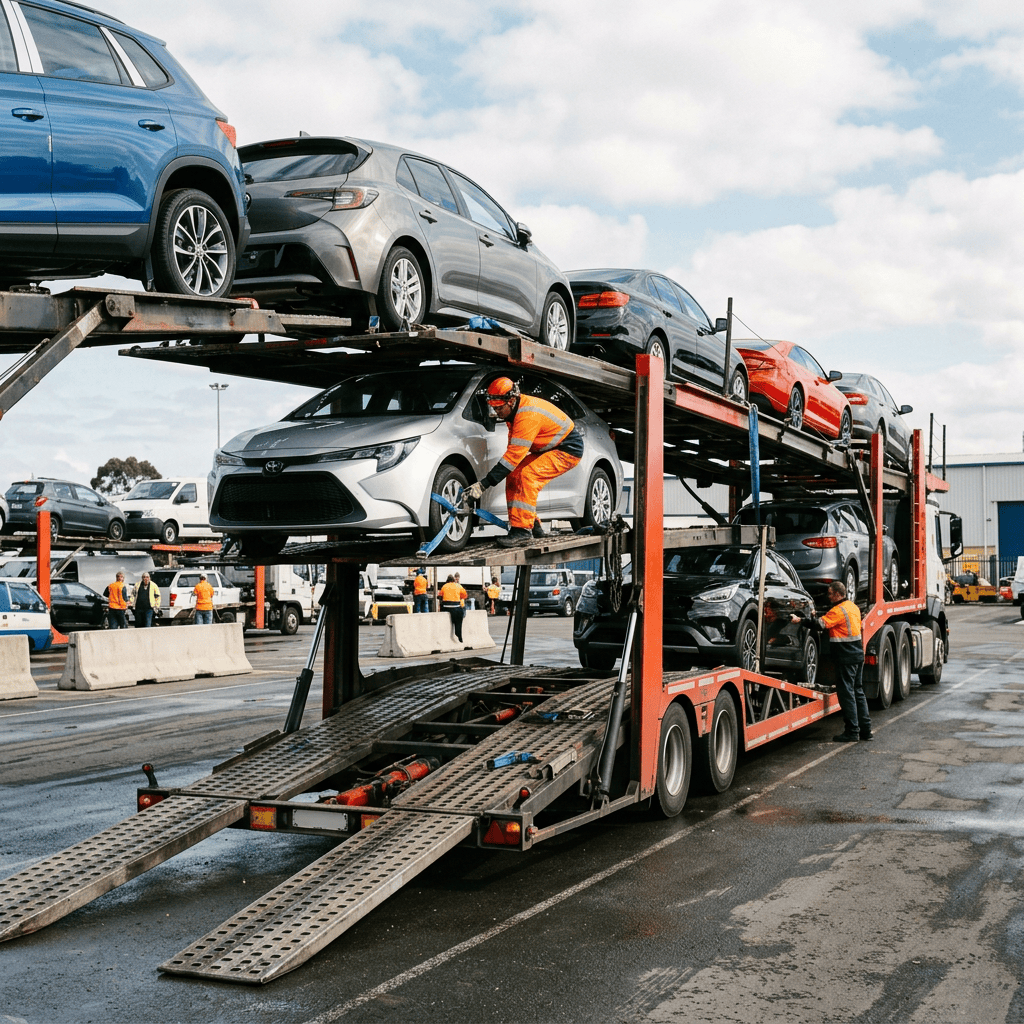
Car carriers secure vehicles by driving them onto the deck, engaging the handbrake and a gear, and then strapping or chaining each vehicle at several points. Most modern operators use wheel straps that loop over the tyres, plus chocks or wheel stops, so the vehicle is held firmly while its suspension still moves normally. Each vehicle is inspected before loading and checked again shortly after the trip begins.
Here is how the process works step by step, and what vehicle owners can do to help.
Step by Step: How a Car Carrier Is Loaded
- Pre-load inspection. The driver walks around each vehicle, records existing damage, takes dated photos and marks a condition report.
- Deck preparation. The deck is cleared, ramps and hydraulics are checked, and the load plan is confirmed.
- Load sequencing. Vehicles go on in a planned order. Heavier vehicles usually sit low and over the axles, which keeps the centre of gravity down.
- Positioning. Each vehicle is driven or winched into its spot with enough clearance from its neighbours and the deck edges.
- Securing. Handbrake on, gear engaged, wheels chocked, and straps or chains tensioned.
- Final check. The driver checks every strap, the clearances and the overall height before setting off.
Wheel Straps vs Chains: How Vehicles Are Tied Down
Two main methods are used, and many carriers use both depending on the vehicle:
- Wheel (tyre) straps loop over or through the tyre and anchor to the deck. The suspension keeps working with the road, and nothing touches the chassis or suspension parts, which lowers the risk of damage. This is the most common approach for passenger cars.
- Chains and axle or frame tie-downs attach to designated tie-down points, the axle or the frame. They suit heavier vehicles and those where wheel straps do not fit, and they need protective sleeves or pads to avoid marking.
Either way, four contact points per vehicle is the usual baseline. Straps and chains should have a working load limit suited to the vehicle’s weight and be inspected regularly for cuts, fraying and damaged ratchets. Worn webbing is taken out of service.
How to Prepare a Vehicle Before Loading
Owners and dealers can prevent most problems with a few simple steps before handover:
- keep the fuel low (around a quarter tank) to reduce weight
- remove loose items, roof racks and bike carriers where possible
- fold in the mirrors and retract or remove aerials
- switch off or note the alarm so it does not trigger en route
- note existing damage and take your own dated photos
- hand over a full set of keys or fobs
- tell the driver about anything unusual, such as lowered suspension or faulty brakes
Special Cases: Low, Non-Running and Electric Vehicles
- Low-clearance vehicles are loaded with ramp extensions, wheel ramps or a tilting deck to avoid scraping the bumper or sills.
- Non-runners are winched on. Steering and brakes may be locked, so the operator needs to know in advance.
- Electric vehicles are transported on the deck rather than towed, and the owner’s manual should be checked for the recommended transport mode and charge level.
- Tall bakkies and SUVs with canopies or accessories must still fit within the 4.3 metre legal height limit once on the deck.
What Happens After the Vehicles Are Loaded?
Securing does not end when the truck pulls away. Straps settle as the load moves, so good practice is to stop within the first few kilometres to re-check tension, then inspect again at every stop. Drivers also check that nothing has shifted after braking events or rough sections of road.
Weather protection depends on the carrier type. Open carriers expose vehicles to sun, rain and the occasional stone chip, while enclosed carriers are usually chosen for high-value or classic vehicles. GPS tracking adds another layer of oversight, and this article on why real-time tracking matters in logistics explains what it offers.
Why Securing Standards Matter
South African road traffic law requires a load to be secured so that it cannot shift or fall from the vehicle, and drivers can be fined if it is not. Beyond compliance, the practical reasons are damage prevention and insurance: a well-documented, properly secured load makes claims simpler and less likely.
The same principles apply to any freight. This guide to best practices for securing goods in transit covers the fundamentals, and this explainer on how truck carriers move cars safely across South Africa looks at the equipment involved.
Common Loading Mistakes to Avoid
Most transport damage traces back to a small number of avoidable errors:
- strapping through suspension arms, brake lines or other components that were never designed to take load
- over-tightening straps so the tyres or suspension are compressed for the whole trip
- skipping the handbrake or leaving the vehicle in neutral
- placing the heaviest vehicle on the upper deck, which raises the centre of gravity
- ignoring clearance under low bumpers and side skirts when setting ramp angles
- not re-checking strap tension after the first few kilometres
Experienced crews build these checks into their routine, which is why the loading process is deliberately methodical rather than fast.
Frequently Asked Questions
Are cars tied down by the wheels or the frame?
Most passenger cars are secured by the wheels using tyre straps. Chains or frame and axle tie-downs are used for heavier vehicles or where straps do not suit the vehicle.
Can a car be damaged on a car carrier?
It is uncommon, but risks include strap contact, low-clearance scrapes and stone chips on open carriers. Inspections, photos, correct securing and goods-in-transit insurance reduce and cover the risk.
How much fuel should be in a car being transported?
Around a quarter of a tank is the common guideline. It keeps weight down while leaving enough to load and unload.
Are open car carriers safe?
Yes. Open carriers are the standard for everyday vehicles. Enclosed carriers are chosen for high-value, classic or low-clearance vehicles that need extra protection.


Leave a comment