
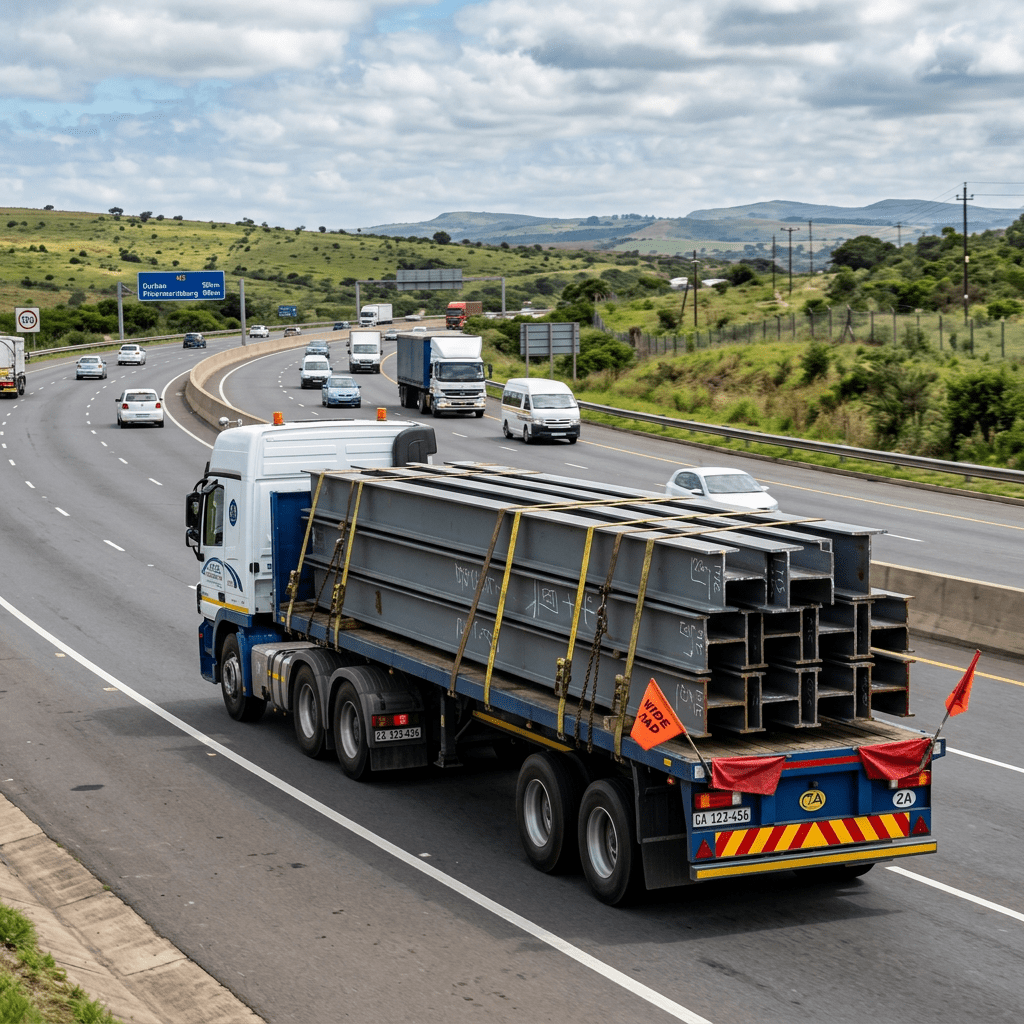
Flatbed truck hire is one of the most versatile and cost-effective transport options available to South African businesses. Whether you are moving construction equipment, agricultural machinery, or event infrastructure, this guide covers everything you need to make an informed decision — from understanding current pricing to choosing the right truck size and vetting a reliable provider.
What is a flatbed truck?
A flatbed truck is a heavy goods vehicle with an open, level cargo bed and no enclosed sides or roof. This design allows cargo to be loaded from the sides, rear, or above using a crane, forklift, or ramp — making it the preferred choice for oversized, heavy, or irregularly shaped loads that cannot fit inside a standard enclosed body truck.
Unlike curtain-side or box-body trucks, a flatbed places no dimensional restrictions on cargo height or width beyond road-legal limits. Strapping points around the perimeter of the bed allow operators to secure loads of almost any shape. This flexibility, combined with the ease of loading and unloading, is why flatbed trucks are found across construction sites, steel yards, agricultural operations, and event logistics throughout the country.
South Africa’s road network — which must serve everything from dense urban industrial zones in Gauteng to remote mining operations in the Northern Cape — makes flatbed hire particularly relevant. The ability to transport a 10-tonne steel structure or a piece of mining equipment from a Johannesburg warehouse to a site in Limpopo without transferring cargo between vehicles is a significant operational advantage.
Types of flatbed trucks available in South Africa
The South African flatbed market is more varied than many operators realise. Understanding the distinctions between vehicle types prevents costly mismatches between cargo requirements and truck capability.
Standard flatbed trucks
The most common configuration. The bed is flat, fixed, and sits at a standard trailer height. Available in load capacities ranging from 1 to 20 tonnes, these trucks handle general cargo: construction materials, steel sections, piping, plant nursery loads, and palletised goods that need overhead loading access. Daily hire rates typically run from R500 for a small 1–2 ton unit to R3,500 for a larger 10-ton vehicle.
Dropside flatbeds
These feature hinged side panels that drop outward, making side-loading significantly easier. Dropside flatbeds are popular for agricultural use, where large quantities of produce, feed bags, or equipment must be loaded and unloaded efficiently at multiple stops. They are also widely used in the building trade for delivering pallets of bricks, roofing tiles, and bagged cement.
Crane-equipped flatbeds
A mounted knuckle-boom or hydraulic crane behind the cab eliminates the need for a separate lifting vehicle at the delivery point. This is a critical cost advantage on remote construction sites where hiring a separate crane truck is impractical. Hire rates are higher — typically R238 to R332 per hour — but the combined transport-and-lift capability often makes it the most economical single-vehicle solution.
Lowbed trailers
Lowbeds have a significantly lower deck height, which allows tall or heavy equipment — such as excavators, bulldozers, and industrial generators — to travel within South Africa’s legal height restrictions. Lowbed hire is priced per trip and per kilometre, with trip rates typically ranging from R1,363 to R1,900 and per-kilometre rates of R14 to R18 for long-distance hauls.
Roll-back flatbeds
The deck tilts and slides rearward, allowing vehicles or equipment to be driven or winched onto the bed from ground level. Roll-back flatbeds are standard for vehicle recovery and the delivery of wheel-mounted machinery that cannot be lifted by crane. They are increasingly used by automotive dealers for transporting multiple vehicles on a single delivery run.
Practical tip
Before requesting a quote, confirm your cargo’s total weight, longest dimension, and whether it requires crane-lifting, forklift access, or side-loading. Providing these details upfront speeds up the quoting process significantly and reduces the risk of being sent the wrong vehicle on collection day.
Current flatbed truck hire pricing in South Africa
Flatbed hire rates in South Africa are structured around three main billing models: hourly, daily, and monthly. Understanding which model suits your project duration is the most reliable way to control costs.
| Truck size / type | Hourly rate | Daily rate | Monthly rate (est.) |
|---|---|---|---|
| Small flatbed (1–2 ton) | R150 – R180 | R500 – R800 | R10,000 – R13,000 |
| Medium flatbed (5–8 ton) | R180 – R220 | R1,200 – R2,000 | R14,000 – R18,000 |
| Large flatbed (10 ton) | R220 – R254 | R3,000 – R3,500 | R18,000 – R25,000 |
| Crane-equipped flatbed | R238 – R332 | R2,500 – R4,500 | POA |
| Lowbed trailer | R1,363 – R1,900 per trip | POA | R35,000+ |
Rates are indicative market ranges for 2025/2026 and exclude fuel, tolls, and driver fees unless otherwise stated by your provider. Always request a written quote. POA = price on application.
What affects the final price?
Several variables push the final invoice above or below the headline rate:
- Fuel: Transport costs across South Africa typically run at R15 to R25 per kilometre on top of the base hire rate, depending on vehicle size and current diesel prices.
- Driver inclusion: Many quotes exclude the driver. If one is needed, confirm the daily driver fee upfront — it is usually billed separately at a standard rate.
- Permit requirements: Abnormal or oversized loads require special permits from the relevant provincial authority and sometimes police escort, adding time and cost.
- Seasonal demand: Rates typically peak between December and February (summer construction season) and soften during the June–August winter period.
- Rental duration: Monthly rentals can deliver savings of up to 25% compared to rolling daily rates. If you need the truck for more than two weeks, request a monthly quote.
- Insurance and damage waiver: Always clarify whether insurance is included or whether a separate damage waiver applies. The liability gap on an uninsured load can be significant.
“The cheapest quote is rarely the most economical option. A flatbed that arrives without the right load-securing gear, or without a driver qualified to haul oversized cargo, can cost far more in delays and liability than a slightly higher rate from a reputable provider.”
Industries that rely on flatbed truck hire
Flatbed trucks serve a remarkably broad cross-section of South African industry. The open-deck configuration removes the dimensional constraints that make enclosed vehicles unsuitable for a wide range of cargo types.
Construction
Structural steel, precast concrete panels, scaffolding, formwork, and heavy plant are all routinely moved on flatbeds. The construction sector accounts for a large share of all flatbed hire activity in Gauteng.
Mining
Mining operations in the Northern Cape, North West, and Mpumalanga rely on flatbeds and lowbeds to move mining equipment, drill rigs, and ore processing machinery between sites.
Agriculture
Combine harvesters, irrigation systems, baling machinery, and bulk produce all require open-deck transport. Agricultural flatbed hire peaks during harvest seasons.
Manufacturing
Industrial machinery, production line equipment, and large fabricated components are transported on flatbeds from factory to installation site — often without disassembly.
Events
Stage structures, large-format screens, sound towers, and exhibition infrastructure all move by flatbed. Event companies in Johannesburg and Cape Town are regular users of crane-equipped flatbeds.
Energy & utilities
Transformers, generators, solar panel arrays, and wind turbine components require the heavy-duty capacity and open-deck access that flatbeds uniquely provide.
Hiring versus owning a flatbed truck
For businesses that move heavy cargo regularly, the hire-versus-own question comes up frequently. The answer depends heavily on utilisation rate and cash flow strategy.
When hiring makes more sense
Hiring is the stronger choice when your need is project-based or seasonal, when you work across different load types that require different truck configurations, or when you want to avoid the capital expenditure and ongoing maintenance costs of ownership. A new 10-ton flatbed truck costs upward of R800,000 to R1.2 million to purchase outright. Depreciation in the first year alone can reach 30%, meaning a vehicle bought for R1 million loses R300,000 of value in twelve months whether it is working or sitting.
Hiring also transfers maintenance liability to the rental company. Breakdowns, tyres, engine servicing, and roadworthiness compliance are the provider’s problem — not yours. For SMEs managing tight cash flows, this predictability in monthly costs is a meaningful operational advantage.
When ownership makes more sense
If your business operates a flatbed truck at or near full capacity for more than ten months of the year, and your cargo type is consistent enough that you do not need to swap vehicle configurations, the total cost of ownership over three to five years will likely be lower than cumulative hire costs. Fleet ownership also gives you complete scheduling control — no availability constraints during peak demand periods when hire vehicles are in short supply.
Related reading
See our guide on transport and logistics solutions for South African businesses for a broader look at how to structure your freight strategy across different vehicle types and contract models.
What to check before you hire
The South African flatbed hire market includes a wide spectrum of operators — from well-capitalised national fleets to individual owner-operators working through third-party platforms. The quality of service, vehicle condition, and contractual protections vary significantly between them. Before signing anything, work through the following:
- Operator registration: Confirm the company is a registered transport operator with a valid Operating Licence from the relevant provincial transport department. This is a legal requirement under the National Land Transport Act.
- Vehicle roadworthiness: Ask for the most recent Certificate of Roadworthiness. A truck that fails a roadside inspection mid-journey creates delays and potential liability for both parties.
- Cargo insurance: Determine what cargo insurance (if any) is provided. If the provider does not cover cargo, you will need to arrange your own goods-in-transit cover before the load departs.
- Driver qualifications: Heavy goods vehicle drivers in South Africa must hold a valid Code 14 (EC) licence. For abnormal loads, additional training and authorisation may be required. Ask to see the driver’s licence before the trip.
- Securing equipment: Flatbed hires should include adequate lashing straps, chains, corner protectors, and — where required — load-spreading mats. Confirm this is part of the hire or that you are responsible for supplying it.
- Cancellation and delay policy: Understand the financial implications of a cancelled or delayed booking. Some providers charge a standing day fee if the truck arrives on site and cannot be loaded due to factors outside their control.
- Fuel policy: Clarify whether the vehicle is collected and returned full, or whether a separate per-kilometre diesel charge applies.
Watch out for
Quoting platforms that connect you with independent contractors without vetting them directly. These platforms disclaim liability for service quality, pricing accuracy, and insurance coverage. Always deal directly with the transport operator and get everything in writing.
Regional pricing differences across South Africa
Where you hire — and where you need the truck to operate — has a direct effect on pricing. The South African market is not uniform.
Gauteng (Johannesburg and Pretoria)
Gauteng remains the most competitive flatbed hire market in South Africa. The province contributes approximately 35% of national GDP and hosts the highest concentration of construction, manufacturing, and logistics activity in the country. High vehicle availability and strong inter-provider competition keep rates roughly 5% lower in Johannesburg than in Pretoria. Johannesburg is generally the cheapest major market, and January is typically the most cost-effective month to book.
Cape Town and the Western Cape
Flatbed hire rates in Cape Town run slightly higher than Gauteng, driven by lower fleet availability and somewhat lower demand relative to the size of the provider base. The Western Cape construction and agricultural sectors generate consistent demand, but the overall market is smaller. Budget for rates approximately 10–15% above Johannesburg equivalents.
Durban and KwaZulu-Natal
Durban’s port activity generates significant flatbed demand for import/export cargo moving to and from the harbour. Rates are broadly comparable to Cape Town. The KwaZulu-Natal sugar and timber industries also drive agricultural flatbed hire in the region.
Other regions
In smaller cities and rural areas, fleet availability shrinks considerably. Providers in Bloemfontein, East London, and George typically charge more per unit because they face less direct competition, even if underlying demand is lower. For remote sites — mine operations in the Northern Cape, for example — expect mobilisation surcharges on top of standard hire rates.
Long-distance flatbed hire: what changes
Long-distance flatbed hire — any journey covering more than roughly 200 km — involves a different cost structure to local or regional hire. Understanding these differences prevents budget surprises.
Transport costs for long-distance flatbed hire typically run at R15 to R25 per kilometre, depending on vehicle size. A 10-ton flatbed travelling from Johannesburg to Durban (approximately 560 km) will accumulate R8,400 to R14,000 in per-kilometre charges before the daily hire rate is factored in. For inter-province moves, per-kilometre rates can rise to R25 to R40 per kilometre on specialised or heavy vehicles.
Return legs and deadhead costs
One of the most overlooked costs in long-distance flatbed hire is the return trip. Unless the provider has a return load lined up — which is not always possible — they will charge for the empty return journey. This can effectively double the transport cost on a one-way move. Discuss return-leg pricing explicitly before confirming a booking.
Driver rest and overnight accommodation
The Road Traffic Act imposes strict limits on consecutive driving hours. On long-distance hauls, the driver will require rest stops and potentially overnight accommodation. Clarify upfront whether these costs fall to you as the client or whether they are absorbed into the hire rate.
Toll costs
South Africa’s e-toll and toll-gate network adds cost to long-distance movements. SANRAL toll costs on routes such as the N1 Johannesburg–Cape Town corridor or the N3 to Durban can be substantial for heavy vehicles. Some providers include tolls in their per-kilometre rate; others bill separately. Confirm in writing before departure.
Cost-saving tip
For long-distance hauls of heavy or specialised equipment, compare the total cost of flatbed hire — including return-leg fees, tolls, and driver accommodation — against the alternative of a specialist freight forwarding company that can consolidate your load with others on a shared route. For infrequent or very long hauls, consolidation can offer meaningful savings. Our team at FLCC Solutions can advise on the most cost-effective freight model for your specific route and cargo type.
Frequently asked questions
How much does flatbed truck hire cost in South Africa?
Hourly rates run from R150 for a small 1–2 ton flatbed to R254 for a larger heavy-duty vehicle. Daily rates range from approximately R500 for smaller models to R3,500 or more for 10-ton trucks. Monthly rentals span R10,000 to R25,000 depending on vehicle size. These figures exclude fuel, tolls, permits, and driver fees unless your provider states otherwise.
What is a flatbed truck used for in South Africa?
Flatbeds are used across construction, mining, agriculture, manufacturing, events, and logistics. Their open deck allows transport of long, wide, or irregularly shaped loads — steel beams, excavators, irrigation pivots, stage equipment — that cannot fit inside enclosed body vehicles.
Is it cheaper to hire a flatbed in Johannesburg than in Cape Town?
Generally, yes. Johannesburg and the broader Gauteng market tend to offer more competitive rates due to higher fleet availability and stronger competition between providers. Rates in Cape Town and Durban run roughly 10–15% higher than Gauteng equivalents.
What size flatbed truck do I need?
For most construction and general cargo needs, a 5–8 ton flatbed is the most common choice. For oversized or industrial equipment, a 10-ton or larger vehicle is typically required. If your load is exceptionally heavy or tall, a lowbed trailer may be more appropriate. When in doubt, provide the cargo dimensions and weight to your provider and let them recommend the correct vehicle.
Do flatbed hire companies in South Africa provide a driver?
Most providers offer a driver-included option, but this is often priced separately from the vehicle hire rate. Always confirm whether the quoted rate includes a driver, and check that the driver holds a valid Code 14 (EC) heavy goods vehicle licence. For abnormal loads, confirm the driver has any additional required authorisations.
Do I need a special permit for an oversized load on a flatbed?
Yes. In South Africa, loads exceeding standard road dimensions or weight limits require an abnormal load permit issued by the relevant provincial transport authority. Some routes may also require a police escort or advance route survey. Your transport provider should handle permit applications, but confirm this is included in the service before booking.
When is the cheapest time to hire a flatbed truck in South Africa?
The South African truck hire market is generally least expensive during the winter months of June through August when construction and agricultural activity slows. January, despite being a summer month, can also offer competitive rates in Johannesburg as the market reopens after the December shutdown. Avoid booking during peak construction season (December to February) if cost is a primary concern.


Leave a Reply