
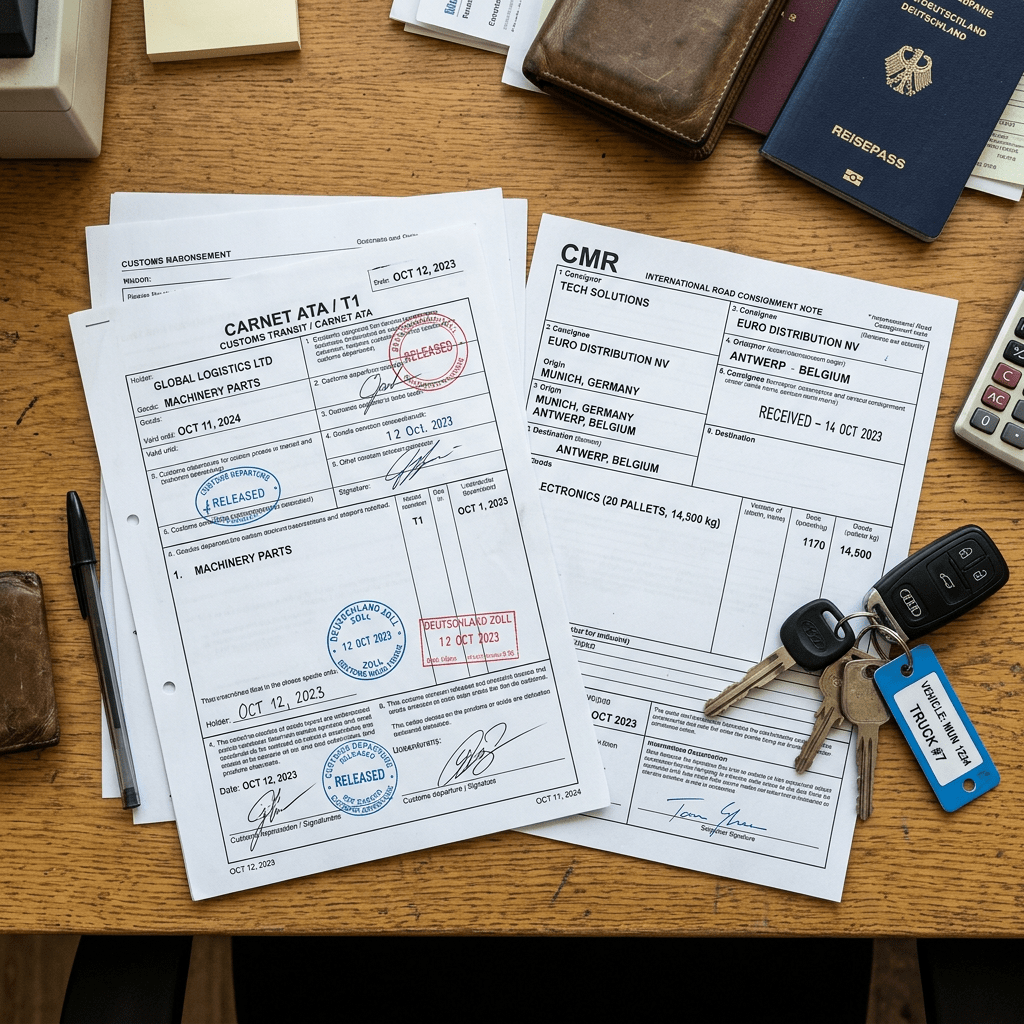
Moving freight across South African borders involves more than loading a truck and pointing it north. Operators who arrive at a border post without the correct permits, customs declarations, or vehicle documentation face delays, fines, or cargo detention — all of which carry significant cost. This guide covers what you need, why you need it, and how to prepare.
Who needs a cross border permit?
Any operator transporting goods or passengers across South African borders for commercial purposes, where the vehicle or combination of vehicles exceeds 3,500 kg total mass, requires a cross border permit from the C-BRTA. This applies equally to South African-registered vehicles operating in SADC countries and to foreign-registered vehicles operating commercially within South Africa.
The legal basis is the Cross-Border Road Transport Act 4 of 1998, which established the Cross-Border Road Transport Agency (C-BRTA) as the regulatory body responsible for issuing and managing these permits. The Act applies to all commercial road transport between South Africa and its neighbouring SADC member states — Botswana, Eswatini, Lesotho, Mozambique, Namibia, Zimbabwe, Zambia, and others further north.
The primary purpose of the permit system is to facilitate the movement of freight and passengers across borders without unnecessary delays, while ensuring operators meet baseline vehicle, insurance, and compliance standards. A valid permit at the border post significantly reduces inspection time and the risk of being turned away.
Types of cross border permits
The C-BRTA issues different permit categories depending on what is being transported and the vehicle type involved. Choosing the wrong category is a common and avoidable error.
Goods permits (Class 1 and Class 2)
Goods permits cover the commercial transport of physical cargo across SADC borders. Class 1 applies to vehicles with a gross vehicle mass at or below 20,000 kg, while Class 2 covers heavy freight vehicles exceeding 20,000 kg. Both are available as three-month or one-year permits. Class 2 fees are quoted individually based on the vehicle and route.
Passenger permits
Bus and minibus taxi operators carrying paying passengers across borders require separate passenger permits. Tourist permits are available for operators moving tour groups, and organised group permits cover non-commercial group travel. These are distinct from goods permits and cannot be substituted for one another.
Cabotage permits
A cabotage permit is required when a foreign transport operator collects and delivers cargo or passengers between two points within the same country. An example would be a Zimbabwean trucking company picking up a load in Johannesburg and delivering it to Cape Town. This activity requires explicit authorisation and is more restricted than standard cross-border transport.
Important
Each vehicle in a fleet requires its own permit. A single permit cannot be transferred between trucks. If you operate multiple vehicles on cross-border routes, budget for individual permit costs per vehicle and track renewal dates separately for each.
How to apply for a C-BRTA permit
Applications are processed through the C-BRTA’s Cross-Easy online portal at cbrta.co.za. The process requires creating a profile, selecting the appropriate permit type, uploading the required documentation, and paying the applicable fee. In-person applications can be submitted at the C-BRTA offices in Eco Park, Centurion, during operating hours (Monday 9am–4pm; Tuesday to Friday 7:30am–4pm, with a 2pm cut-off for same-day processing).
The core documentation required for a goods permit application includes a valid Certificate of Roadworthiness, the vehicle’s registration certificate, company registration documents, and proof of tax clearance with SARS. Operators must also confirm the route they intend to travel, including all transit countries, even if goods are not collected or delivered there.
Required documents for cross border freight
The permit is the operator’s authorisation to cross the border. It is separate from the documentation required for the cargo itself. Customs clearance of goods requires a different, parallel set of paperwork.
| Document | Purpose | Who is responsible |
|---|---|---|
| C-BRTA cross border permit | Authorises the vehicle to operate commercially across the border | Transport operator |
| Commercial invoice | Describes goods, value, and parties to the transaction for customs assessment | Exporter / seller |
| Packing list | Itemises cargo contents; must match invoice and SAD exactly | Exporter / seller |
| Road Freight Manifest (RFM) | Electronic declaration of all goods on the vehicle, submitted via SARS ACM before reaching the border | Transport operator / customs agent |
| Single Administrative Document (SAD) | SARS customs declaration form covering imports, exports, and transit movements | Clearing agent / importer |
| Certificate of origin | Required when claiming preferential duty rates under SADC or AfCFTA trade agreements | Exporter / chamber of commerce |
| Certificate of roadworthiness | Confirms vehicle meets roadworthy standards; required for permit application and border inspection | Transport operator |
| Driver’s licence (Code 14 / EC) | Valid heavy goods vehicle licence required for the truck driver | Driver |
* Specific cargo types — hazardous materials, controlled goods, foodstuffs, pharmaceuticals — may require additional permits or inspection certificates from relevant government departments.
SARS customs clearance and the SAD
Customs clearance for cross-border road freight in South Africa is managed by SARS Customs, a division of the South African Revenue Service. All road freight operators are required to register on SARS’s Automated Cargo Management (ACM) system and submit a Road Freight Manifest electronically before arriving at the border post. This pre-submission — done via Electronic Data Interchange (EDI) — allows SARS to assess the cargo declaration in advance, significantly reducing physical inspection time at the gate.
The Single Administrative Document (SAD) is the primary customs declaration form for imports, exports, and transit movements. It must be completed accurately and filed with SARS before goods are cleared. The information on the SAD must correspond exactly with the commercial invoice, packing list, and any bill of lading or consignment note. Discrepancies between documents are one of the most common causes of border delays and can result in cargo being held for examination.
Common compliance error
Mismatches between the commercial invoice value and the declared customs value trigger SARS scrutiny and can result in re-valuation of duties owed. SARS applies the GATT valuation code, which uses the transaction value of goods as the primary basis for duty assessment. Undervaluation — deliberate or accidental — carries penalties.
Operators who do not have their own EDI registration should work with a licensed customs clearing agent. Clearing agents are accredited by SARS and handle manifest submissions, SAD filing, duty payments, and communications with customs on behalf of their clients. For businesses moving cross-border freight infrequently, using a clearing agent is typically more cost-effective than maintaining in-house EDI capability.
SADC trade agreements and duty savings
South Africa is a member of both the South African Customs Union (SACU) — which includes Botswana, Eswatini, Lesotho, and Namibia — and the broader SADC Free Trade Area. Goods moving between SACU member states generally do not attract import duties, as these countries operate under a shared customs territory. For non-SACU SADC countries such as Mozambique, Zimbabwe, and Zambia, the SADC Free Trade Agreement provides preferential tariff rates on qualifying goods.
To claim these preferential rates, goods must be accompanied by a valid certificate of origin confirming they meet the SADC rules of origin. Without this certificate, customs will assess duties at the standard (most-favoured nation) rate, which can be significantly higher. For exporters moving goods regularly into SADC markets, correctly managing certificates of origin has a direct impact on landed cost.
South Africa’s participation in the African Continental Free Trade Area (AfCFTA) is also expanding the scope of preferential trade arrangements. Operators moving goods to AfCFTA member states should verify current tariff schedules and origin requirements, as these are updated periodically as the agreement is phased in.
Practical tips for smoother border crossings
- Pre-clear electronically where possible. Many South African border posts now support pre-clearance via SARS EDI. Submitting your manifest and SAD before the truck departs can reduce border waiting time from hours to minutes.
- Check border operating hours in advance. Not all South African border posts operate 24 hours. Arriving at a closed border with a perishable load or a time-sensitive consignment is an avoidable and costly mistake.
- Carry physical copies of all documents. Electronic pre-clearance does not eliminate the need for hard copies. Border officials may request originals of the invoice, packing list, and permits for physical inspection.
- Confirm permit validity before departure. C-BRTA permits have defined validity periods. An expired permit at the border results in the vehicle being turned away. Set renewal reminders well ahead of expiry dates.
- Verify route compliance. Your C-BRTA permit specifies the route. Deviating from the approved route — even for operational convenience — constitutes a permit violation. If the route changes, apply for a permit amendment before departing.
- Understand the transit rule. You only need a permit for countries where goods are loaded or offloaded. Transit countries do not require separate permits, but the route through them must be declared in your application.
Related reading
If you are planning to move heavy equipment or oversized cargo across borders, read our guide on flatbed truck hire in South Africa for information on vehicle types, abnormal load permits, and what to check before dispatching a heavy haul.
Frequently asked questions
Who needs a cross border permit in South Africa?
Any commercial operator transporting goods or passengers across South African borders in a vehicle or vehicle combination exceeding 3,500 kg total mass. This includes South African operators moving into SADC countries and foreign operators moving commercially within South Africa.
What documents are required for cross border freight transport from South Africa?
The core set includes a valid C-BRTA permit, commercial invoice, packing list, Road Freight Manifest (submitted electronically via SARS ACM), Single Administrative Document (SAD), certificate of origin where preferential duties apply, Certificate of Roadworthiness, and the driver’s Code 14 licence.
Do I need a separate permit for each country I pass through?
No. You only need a permit for the country where goods or passengers are collected or delivered. Transit countries do not require a separate permit, but your full route — including transit countries — must be declared in your C-BRTA application.
Does each truck in a fleet need its own cross border permit?
Yes. Permits are vehicle-specific and cannot be shared across a fleet. Each truck operating across South African borders requires its own permit.
How do I apply for a cross border permit in South Africa?
Applications are submitted via the C-BRTA’s Cross-Easy portal at cbrta.co.za. You will need a profile, the correct permit type selected, supporting documents uploaded (roadworthy certificate, vehicle registration, company registration, tax clearance), and payment of the applicable fee. In-person applications can be made at the C-BRTA offices in Eco Park, Centurion.


Leave a Reply