
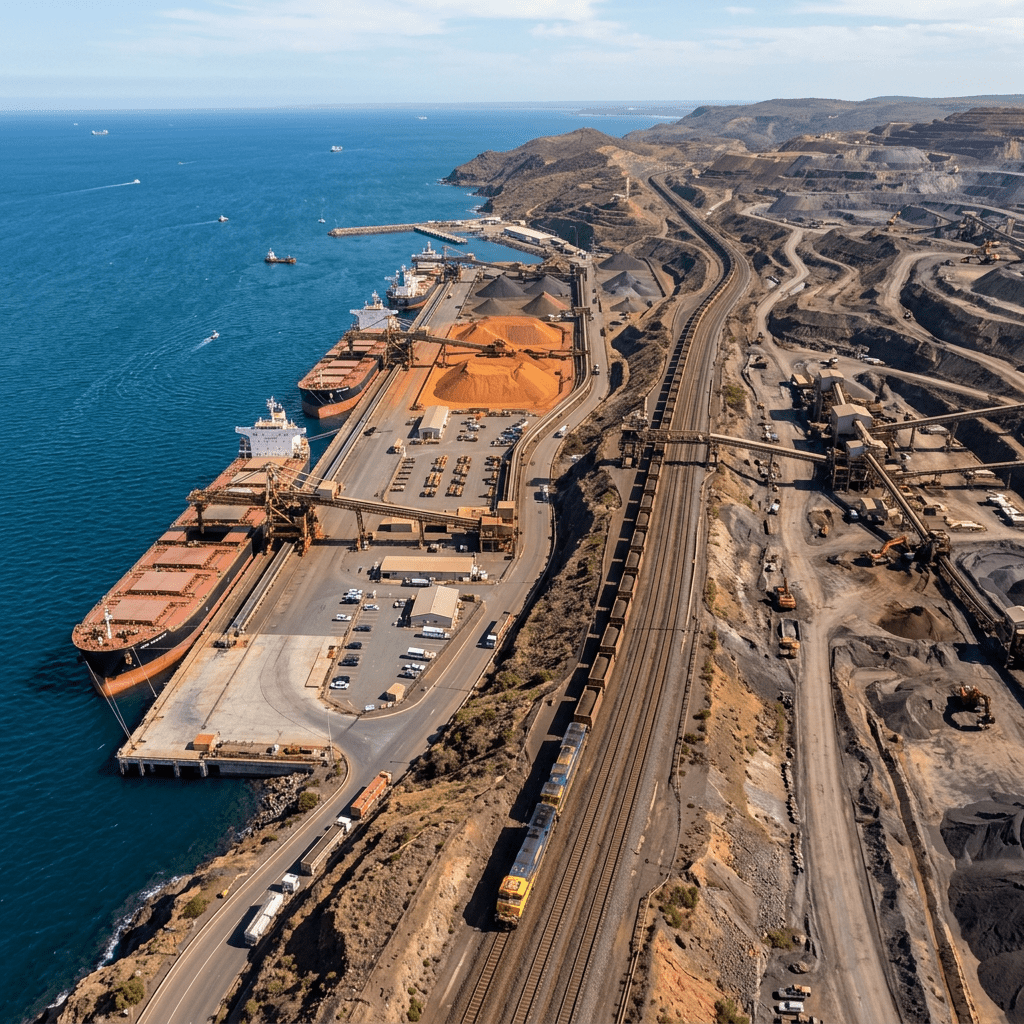
South Africa sits on some of the most mineral-rich geology on earth. The country is among the world’s top producers of platinum group metals (PGMs), gold, chromium, manganese, coal, and iron ore — commodities that must travel hundreds or thousands of kilometres from remote inland mines to industrial customers, smelters, and export ports before they generate value.
Getting that logistics chain right is not straightforward. It involves choosing the correct transport mode, complying with a dense web of national and international regulations, coordinating with state-owned infrastructure operators, managing dust and environmental risks, and aligning production schedules with port and rail capacity. This guide explains how mineral transport works in South Africa — from mine gate to export market.
1. Understanding South Africa’s Mining Transport Landscape
South Africa’s mining sector produced output valued at approximately R580 billion in 2024, with coal accounting for 30% of production volume, PGMs 25%, gold 15%, iron ore 10%, diamonds 5%, and industrial minerals 15%. The sector is underpinned by infrastructure that includes 800 operating mines, 4 major ports for mineral exports, and extensive rail and road logistics networks dedicated to bulk transport.
Most of South Africa’s mineral wealth lies far inland — in Mpumalanga, Limpopo, the Northern Cape, and North West Province — while the country’s export infrastructure is coastal. This fundamental geographic reality means that efficient, cost-effective mine-to-port logistics is not just operationally important; it is existential for the economics of mining.
Key minerals such as chrome, manganese, and coal, which are produced inland, must travel hundreds of kilometres along complex mine-to-port logistics networks before reaching international markets. This journey follows export corridors — integrated routes that connect mining regions across the region with ports through road, rail, and border infrastructure.
2. The Four Modes of Mineral Transport
South Africa uses four primary modes to move minerals from mine to market. Each has different cost structures, capacity limits, suitability by mineral type, and regulatory requirements.
| Mode | Best suited for | Key advantage | Key limitation |
|---|---|---|---|
| Road (truck) | Short to medium haul, flexible routes | Door-to-door, accessible | Higher cost per ton, road wear |
| Rail | High-volume, long-distance bulk | Low cost per ton, high capacity | Fixed routes, Transnet dependency |
| Conveyor belt | On-site or short-distance bulk | High throughput, continuous | Limited to fixed installations |
| Slurry pipeline | Fine-particle minerals over fixed routes | Very efficient for suitable minerals | High capital cost, limited flexibility |
Most mineral supply chains in South Africa use a combination of these — trucks for the final kilometre from pit to processing plant or rail siding, then rail to port, then a ship for export.
3. Road Transport for Minerals
Road is the most flexible and widely used mode for mineral transport in South Africa, particularly for:
- Mine to processing plant or smelter (short haul)
- Mine to rail siding or loading facility (feeder transport)
- Remote mines not served by rail
- Construction aggregates, sand, and stone (high-volume, short-distance)
- Time-sensitive or lower-volume consignments
Vehicle Types Used in Mineral Road Transport
Side tipper trucks (34-ton interlink): The workhorse of bulk mineral road transport. The hydraulic mechanism tips the load sideways, allowing rapid offloading at processing plants and rail sidings. Widely used for coal, chrome, manganese, and aggregates. Unitrans — Africa’s largest road train operator — runs road trains capable of transporting up to 130 tons per load, dramatically reducing the number of trips and cost per ton.
Rigid tipper trucks (10–30 ton): Used for shorter on-mine or inter-site movements. Easier to manoeuvre on mine access roads than interlink configurations.
Flatbed and lowbed trailers: For transporting mineral processing equipment, crushers, and heavy machinery to and from mine sites.
Tanker trucks: For liquid mineral by-products, chemical reagents used in processing, and slurry transport between facilities.
Road Transport Regulations for Minerals
Road-based mineral transport in South Africa is governed by the National Road Traffic Act 93 of 1996 (NRTA) and associated SANS (South African National Standards) codes. Key compliance requirements include:
- Axle load limits: Overloaded trucks cause disproportionate road damage and attract heavy penalties. Operators must comply with axle mass limits prescribed under the NRTA.
- Abnormal load permits: Loads exceeding standard dimensions or mass require route permits from the relevant provincial or national road authority. Escort vehicles may be mandated.
- Driver licensing: Drivers of heavy vehicles must hold the correct Code C1 (Code 10) or Code EC (Code 14) licence, plus a Professional Driving Permit (PrDP) endorsed for goods (G classification).
- Vehicle roadworthiness: All vehicles must hold a valid roadworthiness certificate and operator card.
- Dust control: Transporters are required to cover loads of fine material (coal fines, chrome fines) to prevent dust emissions during transit. Uncovered loads risk environmental citations and damage claims.
4. Rail Transport: Transnet Freight Rail
For large-volume, long-distance mineral transport, rail is the most economical mode — when it works. Transnet is responsible for the major rail lines used to transport bulk commodities and the ports through which the materials are exported, via its operating divisions: Freight Rail and Port Terminals.
Transnet Freight Rail’s core business is freight logistics for mining and heavy manufacturing. Its rail infrastructure represents about 80% of Africa’s total. The network connects South Africa’s inland mining regions with coastal export ports and domestic industrial consumers.
Key Minerals Transported by Rail
- Coal (Mpumalanga to Richards Bay — South Africa’s premier heavy-haul line)
- Iron ore (Northern Cape to Saldanha Bay — the Ore Export Line)
- Manganese (Northern Cape to Port Elizabeth / Ngqura)
- Chrome and PGMs (Limpopo, North West to Durban)
- General bulk minerals on the general freight network
How to Access Transnet Rail for Mineral Transport
Mining companies seeking rail capacity for mineral exports typically engage Transnet Freight Rail directly through a commercial contract. The process involves:
- Volume and route assessment: Submitting a formal expression of interest to Transnet Freight Rail, specifying the mineral type, monthly/annual volume, origin point (mine or siding), and destination (port or industrial facility).
- Siding assessment: If the mine does not have a direct rail siding, an assessment is conducted on whether an existing nearby siding can be used or a new connection is feasible.
- Service level agreement: Once capacity is confirmed, a take-or-pay contract governs the arrangement, specifying volumes, rates, loading windows, and performance penalties.
- Third-party access: South Africa’s rail liberalisation reforms — introduced under the Economic Regulation of Transport Act 6 of 2024 — are progressively opening the rail network to private operators, which will allow mining companies alternatives to Transnet Freight Rail for haulage on the state-owned network.
Rail Performance Context
Rail freight transport in South Africa has been in decline for years. Peak demand was reached in 2017 at 226.3 million tons, but by 2022 volumes had fallen by 34% to a historic low of 149.5 million tons, primarily due to deteriorating network performance characterised by delays, poor maintenance, equipment shortages, cable theft, and vandalism.
The consequence has been significant: in Richards Bay, over 300,000 trucks a year are now entering the port as rail failures force bulk minerals onto road transport, creating queues of trucks stretching along major access roads such as the N2.
Recovery efforts are underway. South Africa’s target is to raise total rail haulage to 250 million tons per annum by 2029. Transnet has entered into strategic partnerships with mining firms — including a 2025 agreement with Exxaro Resources for coal transport from Mpumalanga, and a 10-year deal with United Manganese of Kalahari (UMK) for manganese transport from the Northern Cape to export ports. Dedicated corridor improvement teams have already reduced train turnaround times by 18% on key mineral export routes.
5. Port Export Corridors and Terminals
Once minerals reach the coast by rail or road, they are exported through South Africa’s four major bulk commodity ports, each associated with specific minerals and inland corridors.
Richards Bay (KwaZulu-Natal)
The premier bulk export port for coal. The 594 km coal line connects the coal mining areas near Witbank in Mpumalanga with the coast at Richards Bay and currently moves some 80 million tons of export coal a year. Richards Bay Coal Terminal (RBCT) is one of the world’s largest coal export terminals. The port also handles chrome, manganese, ferrochrome, and other bulk minerals.
Saldanha Bay (Western Cape)
Dedicated to iron ore from the Northern Cape (Sishen and surrounding operations). The 861 km Ore Export Line links Sishen with Saldanha Bay through some of the most remote terrain in South Africa. Saldanha Bay is the deepest natural harbour in the Southern Hemisphere and can accommodate the largest bulk carriers.
Port Elizabeth / Ngqura (Eastern Cape)
The primary export point for manganese from the Northern Cape’s Kalahari Manganese Field — the world’s largest known manganese deposit. The port also handles chrome and general bulk minerals on the Eastern Cape corridor.
Durban (KwaZulu-Natal)
South Africa’s busiest general port and a significant export point for coal, chrome, and general freight. Durban also serves as the primary import hub for mining equipment and reagents.
Port Export Documentation Requirements
Mineral exporters must comply with SARS (South African Revenue Service) customs requirements and the relevant commodity-specific export regulations. Key documentation includes:
- Commercial invoice and packing list
- Bill of lading (for sea freight)
- Certificate of origin
- Quality and assay certificates (especially for PGMs and gold)
- Export permit (for certain regulated minerals including diamonds, certain PGMs, and designated strategic minerals)
- SARS customs declaration (DA 550 or equivalent)
- Shipping instruction to the freight forwarder or port agent
For hazardous mineral cargo (classified dangerous goods), additional documentation is required — see Section 9.
6. Conveyor Belts and Slurry Pipelines
Conveyor Belts
Conveyor systems are the most cost-effective method of moving large volumes of bulk material over short to medium fixed distances — typically within a mine, between a pit and a processing plant, or from a processing plant to a rail loading or stockpile facility. Major mining operations use multi-kilometre overland conveyors to eliminate truck haulage entirely on high-volume routes.
Conveyors are capital-intensive to install but have very low operating costs per ton once in place and are preferred for continuous, high-throughput applications such as coal mine run-of-mine (ROM) to the plant, or crushed ore from the primary crusher to the mill.
Slurry Pipelines
Slurry pipelines transport finely ground mineral material mixed with water over long distances in a pressurised pipeline. They are used where the mineral can be efficiently processed into a pumpable slurry and where the route is fixed and volume is consistently high. Pipelines are the most efficient method of coal transportation but are also the most expensive to build.
In South Africa, slurry pipelines are used in phosphate, iron ore, and certain coal applications. They are not suitable for all minerals and require significant upfront capital, environmental approvals, and water use authorisation — particularly challenging in a water-scarce country.
7. Key Mine-to-Port Corridors in South Africa
Understanding which corridor serves which mineral and which mining region is essential for logistics planning.
The Coal Corridor: Mpumalanga → Richards Bay
South Africa’s highest-volume mineral export corridor. Coal from the Witbank, Middelburg, Ogies, Kriel, and Secunda coalfields moves by road to rail sidings, then by dedicated heavy-haul rail to Richards Bay for export. Rail is the preferred mode at scale; road trucking to the port is used when rail capacity is constrained.
The Iron Ore Corridor: Northern Cape → Saldanha Bay
Sishen mine and surrounding iron ore operations supply the 861 km Ore Export Line operated by Transnet. This is one of the most efficient heavy-haul rail operations on the continent. Road plays a limited role on this corridor given the volumes and distances involved.
The Manganese Corridor: Northern Cape → Port Elizabeth / Ngqura
Manganese from the Kalahari Manganese Field near Hotazel and Kuruman moves by road and rail via Upington and De Aar to Port Elizabeth and Ngqura. Congestion on this corridor has been a persistent challenge. The 2025 UMK–Transnet 10-year deal is intended to address this systematically.
The Chrome and PGM Corridors: Limpopo and North West → Durban / Richards Bay
Chrome and PGM ore from the Bushveld Igneous Complex — centred on Steelpoort, Burgersfort, Rustenburg, and Brits — moves primarily by road truck to smelters and refineries, then by road or rail to export ports. The road distance from these operations to Durban is typically 700–900 km.
The Garden Route and Eastern Cape Corridor
Smaller-scale mineral operations in the Eastern Cape, as well as minerals transiting from inland operations to Port Elizabeth, use a combination of road and rail on the Eastern Cape corridor.
8. Legal and Regulatory Requirements
Mineral transport in South Africa is governed by a layered framework of legislation. Understanding which laws apply to your operation is critical before beginning any transport activity.
Core Legislation
Mineral and Petroleum Resources Development Act 28 of 2002 (MPRDA): The primary mining law governing mineral rights, prospecting, and production. While not a transport law, it governs what minerals may be mined, sold, and exported, and by whom. A mining right or permit is a prerequisite for legally selling or transporting minerals from a mine.
National Road Traffic Act 93 of 1996 (NRTA): Governs all road-based transport including vehicle standards, axle loads, dangerous goods transport, driver licensing, and oversize permits. The associated SANS codes (SANS 10228, SANS 10229, SANS 10230, SANS 10231, SANS 10232) provide detailed specifications for dangerous goods classification, packaging, marking, labelling, and documentation.
Occupational Health and Safety Act 85 of 1993 (OHSA): Applies to health and safety standards at loading and offloading facilities associated with mining operations.
National Environmental Management Act 107 of 1998 (NEMA): Environmental authorisations required for certain transport-related activities (dust generation, water use in slurry pipelines, land use for conveyor routes).
Economic Regulation of Transport Act 6 of 2024 (ERTA): A significant new framework signed into law in June 2024, introducing economic regulation of the transport sector including freight rail. Mining companies seeking third-party rail access should monitor the implementation regulations as they are published.
Customs and Excise Act: Governs export documentation and SARS compliance for mineral shipments leaving South Africa.
Export Permits for Specific Minerals
Not all minerals can be freely exported. The following require specific export permits or are subject to beneficiation requirements that restrict export of unprocessed material:
- Diamonds: Subject to the Diamonds Act 56 of 1986. All rough diamonds must be offered to local buyers before export. Export requires a South African Diamond and Precious Metals Regulator (SADPMR) permit.
- Gold and PGMs: Certain categories require SADPMR export permits. Refined product generally has a simpler export pathway than unprocessed ore.
- Designated strategic minerals: The Draft Mineral Resources Development Bill 2025 proposes enhanced controls over minerals critical to the global energy transition, including lithium, cobalt, and rare earth minerals. These provisions are not yet in force but should be monitored by operators in these commodities.
- Chrome: Subject to beneficiation policy considerations; consult the Department of Mineral and Petroleum Resources for current requirements.
9. Dangerous Goods Classification and Compliance
Many minerals and associated mining materials — including certain ores, chemical reagents, explosives, and by-products — are classified as dangerous goods under South African and international law. Transporting them requires additional compliance steps.
Classification Under SANS 10228
Dangerous goods are classified into 9 UN hazard classes. Mining-relevant categories include:
- Class 1: Explosives (blasting agents, detonators) — extremely regulated
- Class 3: Flammable liquids (diesel, solvents used in mineral processing)
- Class 5.1: Oxidising substances (ammonium nitrate used in blasting)
- Class 6.1: Toxic substances (cyanide used in gold processing)
- Class 8: Corrosive substances (acids used in battery storage and metallurgical processes)
- Class 9: Miscellaneous (asbestos-containing minerals — SANS 10228 UN 2212 and 2590)
Each classified substance has a unique UN number that determines its packaging, marking, labelling, and transport documentation requirements.
Road Transport Compliance for Dangerous Goods
All vehicles must be certified to carry dangerous goods, and this must be displayed on the operator card for each vehicle and trailer. All drivers must be over the age of 25 and hold a PrDP endorsed with a D (dangerous goods) classification, which must be renewed every two years. Renewal requires a dangerous goods certificate (renewable annually) from a Department of Transport-approved provider and a valid medical certificate.
Rail and Port Dangerous Goods Requirements
Transnet’s role in the transportation of dangerous goods is to provide the infrastructure and logistics services — rail, ports, and pipelines — while strictly managing and regulating the movement of these materials to ensure safety and compliance with national and international standards.
For port movements, Transnet National Ports Authority (TNPA) requires advance notification of hazardous cargo — typically 14 days before vessel arrival — along with specific documentation including TNPA explosive permits for Class 1 and 5.1 cargo, and registration forms from the Department of Environmental Affairs for Class 9 asbestos-containing materials.
At the Port of Durban, explosive cargo bound for destinations outside KwaZulu-Natal must leave the port via rail only.
10. Choosing a Mineral Transport Company
What to Evaluate
When selecting a logistics partner for mineral transport, assess the following:
- Fleet capability: Does the operator have the right vehicle configuration for your mineral and volume? Side tippers, road trains, and tankers serve different applications.
- Compliance record: Request evidence of valid operator cards, roadworthiness certificates, and driver PrDP endorsements. Non-compliant operators expose the mine to liability.
- Mine access experience: Drivers operating on mine sites require mine-specific inductions and must comply with mine safety rules. Operators with established mine relationships understand these requirements.
- Route coverage: Confirm the operator services your specific mine-to-plant or mine-to-siding route. Rates and availability vary significantly by region.
- Track and trace: Real-time load tracking reduces theft risk and gives production planners accurate delivery windows.
- Insurance: In-transit insurance for bulk minerals and liability cover for any environmental or road damage incidents.
- Performance-Based Standards (PBS) approval: For high-payload road trains (up to 130 tons), PBS certification from the Department of Transport is required. PBS-approved operators can legally run heavier configurations with significantly better cost-per-ton economics.
Key Mineral Transport Operators in South Africa
Unitrans: Africa’s largest road train operator, with over 35 years of bulk mining haulage experience. Operates across South Africa, Namibia, Botswana, Zambia, Mozambique, Malawi, Lesotho, Tanzania, Madagascar, and Eswatini. Transports mineral sand, copper, kimberlite, limestone, salt, nickel, chrome, and platinum. Pioneered Performance-Based Systems (PBS) road trains for high-payload combinations.
Simeliza Transport: A Mpumalanga-based specialist in mining logistics, covering coal, chrome, manganese, iron ore, aggregates, and silica. Serves the high-volume mining belt across Witbank, Middelburg, Ogies, Secunda, Kriel, Nelspruit, Steelpoort, Burgersfort, Rustenburg, and the Durban and Richards Bay ports. Offers mine-ready fleet with safety checks and mine-specific inductions.
FLCC Solutions: A growing logistics provider operating the motto “Moving Materials. Building Futures.” FLCC Solutions specialises in heavy bulk haulage, including 34-ton side tippers and tautliners, serving mining, agriculture, and construction clients. The company brings hands-on operational discipline and a flexible, client-focused approach to bulk mineral transport in Gauteng and surrounding mining corridors.
Reinhardt Transport Group: A specialist bulk logistics operator with deep expertise in mine-to-port corridor planning, particularly for chrome, manganese, and coal. Reinhardt approaches mineral logistics as a coordinated corridor system, aligning production scheduling with transport capacity and port scheduling for reliable export performance.
Transnet Freight Rail: The primary rail carrier for large-volume, long-distance mineral transport. Essential for coal (Mpumalanga–Richards Bay), iron ore (Northern Cape–Saldanha Bay), and manganese (Northern Cape–Port Elizabeth). Access is by commercial contract with Transnet.
Cargo Carriers: One of Southern Africa’s leading supply chain and transport logistics providers, serving a range of industries including mining, chemicals, and steel. Broad geographic coverage and specialised fleet configurations.
11. Challenges Facing South Africa’s Mineral Logistics Sector
Understanding the current challenges in South Africa’s mineral transport infrastructure helps mining operators plan more resilient logistics strategies.
Transnet Rail Underperformance
The deterioration of Transnet Freight Rail’s network since 2017 has been the single biggest disruptor of South Africa’s mineral export capacity. Cable theft, vandalism, deferred maintenance, and operational inefficiencies have forced hundreds of millions of tons of mineral freight back onto the road network — at higher cost per ton and with significant road infrastructure damage.
Port Congestion
As rail capacity declined, road trucks substituted — creating severe congestion at mineral export ports, particularly Richards Bay. Over 300,000 truck movements per year now enter Richards Bay port, a situation that was not designed for and which creates significant logistical and safety challenges.
Road Infrastructure Deterioration
The increase in heavy truck movements on roads designed for lighter traffic loads has accelerated road deterioration, particularly on provincial roads connecting mine sites to national highways. This creates a compounding problem: more trucks mean faster road degradation, which increases vehicle operating costs and reduces reliability.
Remote Mine Access
South Africa’s most productive mining regions — the Northern Cape, parts of Limpopo, and North West Province — are served by limited road and rail infrastructure. Remote mine access roads are often unpaved, seasonal (impassable in heavy rain), and unsuited to fully loaded interlink trucks.
Regulatory Complexity
The layered regulatory framework across minerals, transport, environment, and customs creates significant compliance burden, particularly for smaller operators who lack specialist legal and compliance teams.
Theft and Security
Cable theft on rail infrastructure costs Transnet billions of rands annually. Mineral cargo theft from trucks — particularly diesel, copper, and precious metals concentrates — is also a significant risk requiring route security planning and in-transit tracking.
12. Frequently Asked Questions
What is the most cost-effective way to transport large volumes of minerals in South Africa?
Rail is the most cost-effective mode for high volumes over long distances when capacity is available. Road transport costs more per ton but offers greater flexibility and accessibility. For the highest possible road-based payload efficiency, Performance-Based Standards (PBS) road trains — approved for up to 130 tons — offer the best cost-per-ton economics.
Do I need a permit to transport minerals by road in South Africa?
Standard mineral bulk haulage does not require a special mineral transport permit beyond the standard vehicle operator card and driver PrDP. However, oversize loads (abnormal load permits), dangerous goods transport (vehicle certification, driver PrDP with D endorsement), and certain regulated minerals (diamonds, certain PGMs) require additional permits. Consult the Department of Transport and the SADPMR for your specific commodity.
What is a PrDP and why is it required for dangerous goods transport?
The Professional Driving Permit (PrDP) is a supplementary permit required for commercial driving. For dangerous goods transport, the PrDP must carry a D endorsement, which certifies that the driver has completed approved dangerous goods training. All drivers transporting classified dangerous goods must be over 25 and hold a current D-endorsed PrDP.
Can I export minerals directly from a mine without going through a port?
Cross-border mineral exports — for example, coal to Mozambique’s Matola terminal or chrome to Zimbabwe for smelting — do occur by road and rail without using South African ports. However, any cross-border mineral movement requires customs documentation, export permits where applicable, and compliance with the destination country’s import regulations and any bilateral trade arrangements.
How do I get access to Transnet rail for mineral transport?
Contact Transnet Freight Rail’s commercial team directly with details of your mineral type, volume, origin, and destination. Transnet will assess available capacity and siding logistics before issuing a commercial proposal. The introduction of third-party access under ERTA 2024 will eventually allow mining companies to use private train operators on the Transnet-owned network, but implementation regulations are still being developed.
What are the environmental obligations when transporting minerals by road?
At minimum, loads of fine material must be covered to prevent dust emissions. Transporters must also comply with NEMA requirements regarding spill prevention and manage any environmental incidents involving mineral cargo. For certain materials (asbestos-containing minerals, radioactive ores), additional environmental registration and handling requirements apply.
What happens if a truck transporting minerals is involved in an accident?
The transporter, consignor, and consignee all have responsibilities under the NRTA. For dangerous goods incidents, the driver must follow emergency response procedures, notify the relevant emergency services, and report to the authorities. Operators are required to conduct route risk assessments and inform local authorities of dangerous goods routes in advance. Comprehensive liability insurance is essential.
Is it legal to transport gold or PGM concentrate by road truck?
Yes, but precious metals and concentrate transport is subject to strict security and compliance requirements, including SAPS escorted transport for high-value loads in some cases, SADPMR permit compliance, and vehicle security standards. Specialist armoured or secured transport companies operate in this niche.
Summary
Transporting mining minerals in South Africa is a multi-modal, heavily regulated, and operationally complex challenge. The fundamentals are: match the transport mode to your volume and distance (road for flexibility and short haul, rail for large-volume long-distance, conveyors for on-site high throughput), understand and comply with the layered regulatory framework for your specific mineral and its hazard classification, engage Transnet for rail capacity early and with realistic expectations, and work with experienced logistics partners who have mine-site credentials and sector-specific compliance in place.


Leave a Reply