
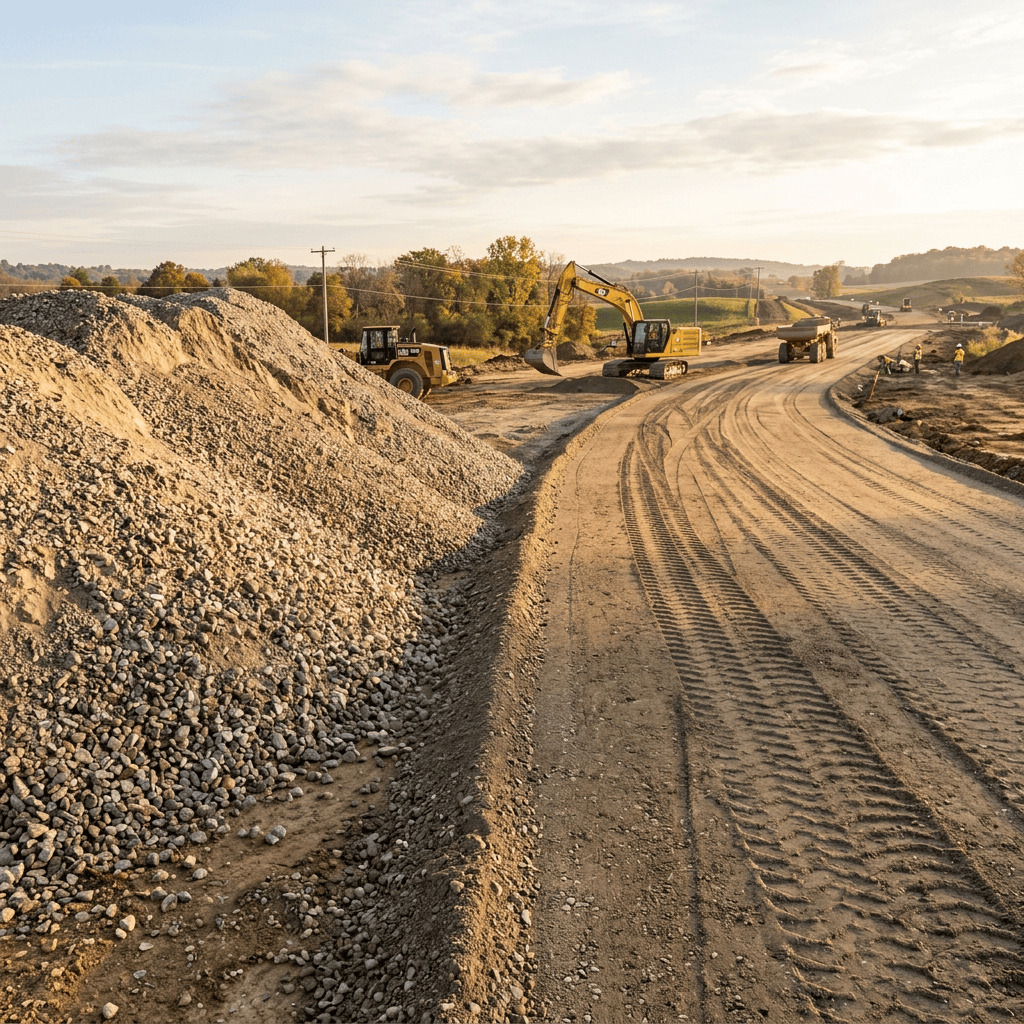
Crusher run and other aggregates are usually delivered to South African construction sites in tipper trucks, ordered either by the ton or by the cubic metre. Delivery cost depends on the material, the quantity, the distance from the quarry, the truck size and how easy it is to reach and tip on your site. Get the quantity right, confirm access before the truck leaves, and always ask for weighbridge tickets so you know what you are paying for.
Aggregates are the bulk material behind almost every construction project, from a house platform to a provincial road. Crusher run is one of the most commonly ordered, and its transport is an area where small mistakes, such as ordering the wrong quantity or sending a truck to an unsuitable site, can waste time and money.
What crusher run is
Crusher run is crushed rock that has not been screened into one size, so it contains a mix of stone sizes together with fine material. Because of this graded mix, it compacts well, which is why it is widely used as:
- Base and sub-base layers for roads, driveways and parking areas.
- Bedding and backfill around pipes and under paving.
- Platforms for buildings, slabs and hardstands.
- Temporary access roads on construction sites.
Common related aggregates include single-size crushed stone in various sizes, gravel, building sand and river sand, and these are often delivered from the same quarry or supplier. Different projects and authorities specify particular grades and sizes, so check the specification in your engineer’s drawings or bill of quantities and ask the supplier to match it.
How aggregates are transported
The standard vehicle is a tipper truck, which lifts its body hydraulically to discharge the load. Options range from small to large:
- Small rigid tippers. Suitable for residential jobs, tight access and small quantities.
- Medium and large rigid tippers. Common on building sites and civil projects, with higher payloads per trip.
- Side tippers and interlinks. Heavy combinations used for large volumes over longer distances, offering high payload and fast offloading.
- Tipper trailers and tri-axle tippers. Used for larger civil contracts.
Smaller tippers may carry only a handful of tons, while large combinations carry many times more, so match the truck to the site. If access is restricted, a big truck may not reach the tipping point, and if the job is large, small trucks will make too many trips.
Tons or cubic metres?
Suppliers price and sell aggregates either by weight (per ton) or by volume (per cubic metre), and mixing the two up is a common source of confusion.
- By weight is verified at the weighbridge, so you know exactly what was loaded.
- By volume depends on the truck’s body size and how it is filled, and can be less precise.
The weight of a cubic metre of crusher run depends on the rock, the grading and the moisture content, and it is often in the range of roughly 1.5 to 1.8 tons per loose cubic metre. Do not rely on rough conversions for large orders. Ask the supplier which unit they use, how they verify it and how the price is calculated.
What determines the delivered price
- The material. Different products and grades have different prices.
- The quantity. Larger orders often attract a better rate per ton.
- The distance. Transport is a big part of the delivered price, and it rises with distance from the quarry.
- The truck size. Larger trucks generally lower the cost per ton on long hauls.
- The site. Steep, muddy, narrow or restricted sites slow deliveries.
- Delivery windows. Deliveries at peak times or outside normal hours may cost more.
- Waiting time. A truck kept waiting to tip may attract standing charges.
- Fuel and tolls. Both feed into the transport rate, especially on longer routes.
Planning a delivery
Good planning saves money on aggregates, and most of it is about information.
Calculate your quantity. Work out the volume from the area and depth, add an allowance for compaction and waste and convert to tons or cubic metres as your supplier requires. If in doubt, ask your engineer or contractor.
Confirm access. Check gate width, overhead cables, soft ground, slopes and turning space. Make sure the truck can reach the tipping area without damaging roads or services.
Prepare the tipping area. Clear it, mark it and make sure someone is there to direct the truck. A trained person on site reduces the risk of accidents.
Schedule deliveries. Tell the supplier your working hours and pace, so trucks arrive at the right rate. If your team cannot spread and compact quickly, a large pile of material may sit in the way or wash away in rain.
Arrange payment and paperwork. Agree on the payment terms and ask for delivery notes or weighbridge slips for every load.
Legal and safety points
- Overloading. Legal payload limits apply to every truck. An operator who overloads to cut costs puts you at risk of delays and fines, and it damages roads. Insist on legal loads.
- Covered loads. Loose material should be covered or otherwise secured where required, to avoid spillage onto the road.
- Driver competence. Heavy vehicle drivers need the correct licence and, where they carry goods for reward, a professional driving permit. Our Code 14 licence guide explains the codes.
- Site safety. Tipping near trenches, embankments and overhead lines is hazardous and should follow the site safety plan.
- Environmental care. Keep material out of drains and watercourses, and manage dust on dry days.
Common mistakes to avoid
- Ordering by volume without confirming how it is measured.
- Not checking access, so the truck cannot reach the tipping point.
- Underestimating quantity and paying for a second delivery with a minimum load charge.
- Ordering too far ahead and leaving a large pile exposed to rain.
- Accepting deliveries without weighbridge tickets.
- Ignoring the specification and receiving the wrong material.
Alternatives to buying delivered material
For projects where you also need a truck of your own for other tasks, hiring a vehicle may be an option. The truck rental page lists the vehicle categories. For a related bulk material that follows similar logistics, see limestone transport in South Africa.
Frequently asked questions
What is crusher run used for?
Base and sub-base layers, bedding, platforms and access roads, mainly because it compacts well.
How is crusher run sold?
By the ton or by the cubic metre, depending on the supplier. Always confirm which.
How much crusher run fits on a truck?
It depends on the truck. Small tippers carry a few tons, and larger ones carry many more, so ask for the legal payload.
Can any truck deliver to my site?
Not always. Access, ground conditions and space to tip determine what can reach you.
What paperwork should I get?
A delivery note or weighbridge ticket for every load.


Leave a comment