
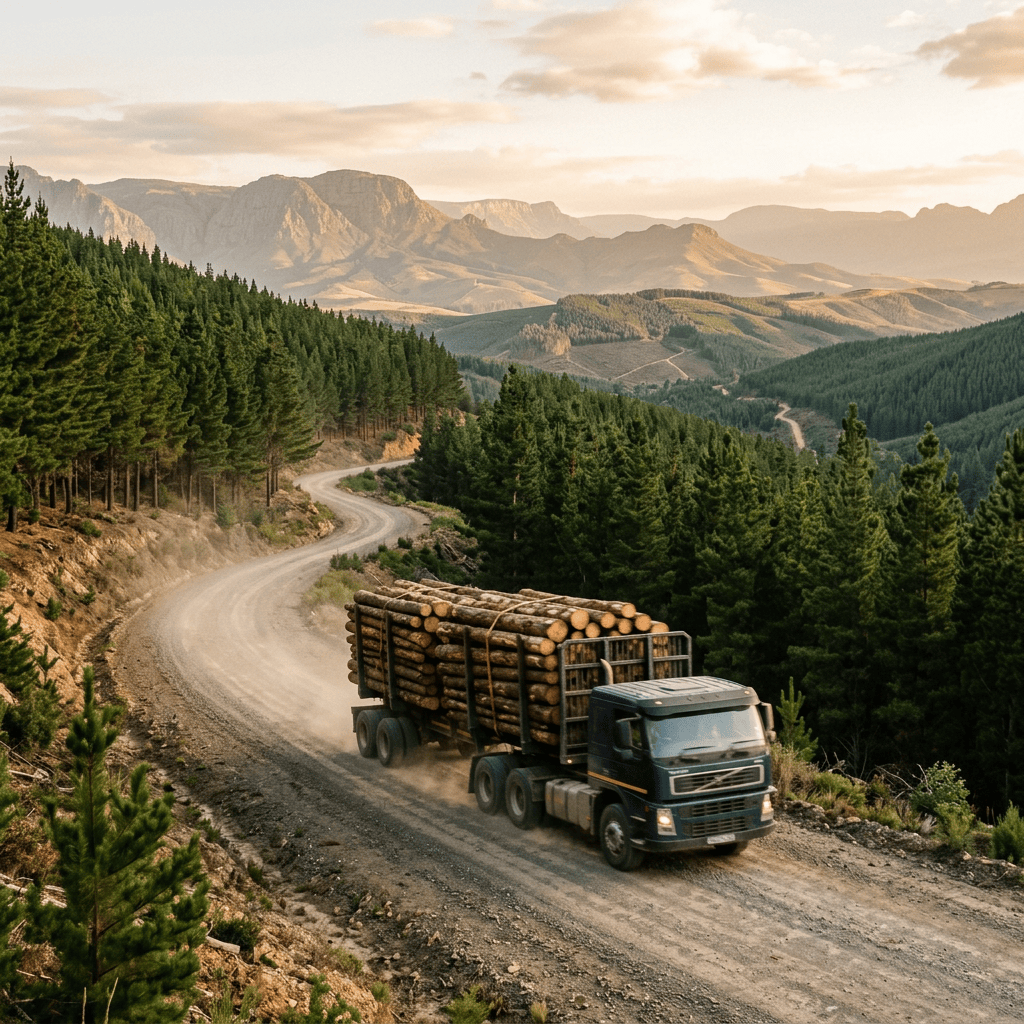
Timber in South Africa is moved by road in specialised log trucks with stakes and loaders, in flatbeds and tautliners for sawn lumber, and in walking-floor or tipper trailers for chips. The main challenges are heavy and awkward loads, long distances from plantations to mills, wet weather on forest roads, and strict load-securing and weight rules. Costs depend on distance, product type, vehicle, load size and turnaround time.
South Africa has a substantial commercial forestry industry, with plantations of pine, eucalyptus and wattle supplying sawmills, pulp and paper mills, mining timber, poles and chip markets. Because timber is bulky and much of the value lies in the wood itself, transport is a large share of the delivered cost, and good logistics can make a real difference.
Where timber moves from and to
Commercial plantations are concentrated in several regions, notably Mpumalanga, KwaZulu-Natal and the Eastern Cape, with additional forestry in Limpopo and the southern and Western Cape. Timber moves from plantations and forestry roads to sawmills, pulp and paper mills, treatment plants, board manufacturers and export terminals. It then travels onward to builders, merchants and manufacturers.
The route from a forest to a mill is often long, and much of it runs on secondary and forest roads before joining provincial or national routes. That makes vehicle choice, driver skill and weather planning especially important.
Timber products and how they travel
Roundwood and logs. Pulpwood, sawlogs and mining timber are carried on log trucks and trailers with bolsters and side stakes, usually loaded by a crane or loader. Loads are long and heavy, and they must be evenly stacked and secured.
Poles. Treated and untreated poles for fencing, power and telecommunications are long and often protrude beyond the vehicle, which may make the load abnormal. Our guide to abnormal load transport in South Africa explains when overhang and length trigger permit requirements.
Sawn timber and lumber. Stacked in packs, sawn timber travels on flatbeds, curtain-siders and tautliners. Covering it protects it from rain and sun, which matters for quality and for moisture content.
Wood chips and sawdust. Moved in walking-floor trailers, tippers or dedicated chip trailers. Chips are bulky and light, so volume rather than weight often limits the load.
Boards and engineered timber. Plywood, chipboard and similar products are shipped in packs on covered trailers, and need protection from moisture.
Vehicle types
- Log trucks and trailers. Built for roundwood, with stakes, bolsters and often an on-board crane.
- Interlinks and semi-trailers. Used for larger volumes of logs and sawn timber on longer hauls.
- Flatbeds and drop-sides. A flexible choice for sawn timber and poles.
- Curtain-siders and tautliners. Offer side loading and weather protection for finished timber and boards.
- Walking-floor and tipper trailers. Used for chips, sawdust and bark.
- Rigid trucks. Suitable for shorter hauls and smaller volumes.
Matching the vehicle to the product is essential. A vehicle that suits sawn timber will not be suitable for logs, and using the wrong equipment increases risk and cost.
Load securing and safety
Timber loads can shift, and logs that come loose are extremely dangerous. Good practice includes:
- Use of bolsters and stakes that are in good condition and correctly positioned.
- Correct restraints, such as chains, straps and binders, suitable for the load and regularly inspected.
- Even stacking so weight is distributed across the axles and the load is stable.
- Cover for sawn timber to protect it from weather and secure it.
- Regular checks during the trip, especially after the first few kilometres and after rough sections.
- Driver training in loading, securing and driving with heavy, high loads.
Forest roads add hazards such as steep gradients, sharp bends and slippery surfaces. Wet timber is heavier than dry timber, so a load that looks legal in the forest can exceed limits once wet, and payload calculations should account for it. Overloading is illegal, damages roads and can void insurance.
Regulations and documentation
Commercial timber transport is subject to road traffic regulations on dimensions, mass and load securing, and heavy combinations require drivers with the correct licence codes and a professional driving permit. Our guide to Code 14 licence requirements explains those requirements.
Depending on the species and product, other documentation may apply. For example, movement of certain protected or indigenous timber can require permits, and buyers may require chain-of-custody records, particularly for certified timber. Weighbridge tickets and delivery notes are standard. Always confirm the requirements for your product and route with the forestry company, buyer or relevant authority.
Seasonal and weather factors
Rain. Wet weather can make forest roads impassable or dangerous, delaying loads and harvesting. Plan for lost days in the wet season.
Fire season. In many timber regions, the dry winter months carry a high fire risk. Fires can close roads and disrupt operations, and vehicles must follow fire-safety rules in plantations.
Peak harvesting periods. Demand for trucks can rise at certain times, so book capacity early.
Fog and visibility. Highland forestry regions can experience heavy fog, which affects safe driving.
What drives the cost of timber transport
- Distance. The haul from plantation to mill is often long, and cost per ton rises with distance.
- Product type. Logs, lumber, poles and chips need different vehicles.
- Load size and weight. Full legal payloads cut the cost per ton, and moisture affects weight.
- Road conditions. Gravel and forest roads slow trucks and increase wear.
- Loading and offloading. Cranes, loaders and yard space affect turnaround.
- Return loads. Empty return trips are priced into the rate.
- Fuel and tolls. Both increase on long routes.
- Seasonality. Weather and demand influence availability and rates.
Choosing a timber transporter
Look for experience with your product and region, proper permits and insurance, well-maintained vehicles with suitable equipment and drivers who know the routes. Ask about load-securing practice, safety record and how they handle delays caused by weather. If you need a general-purpose vehicle for a related job, the truck rental page outlines the categories available.
Frequently asked questions
What trucks transport timber in South Africa?
Log trucks with stakes and loaders for roundwood, and flatbeds, curtain-siders and tautliners for sawn timber.
Is timber transport regulated?
Yes. Road traffic rules on mass, dimensions and load securing apply, and some products may need permits or documentation.
Are long poles an abnormal load?
They can be if their length or overhang exceeds legal limits.
Why does rain matter?
It makes forest roads difficult and adds weight to timber, which can push a load over legal limits.
What affects the cost most?
Distance, product type, payload and road conditions.


Leave a Reply