
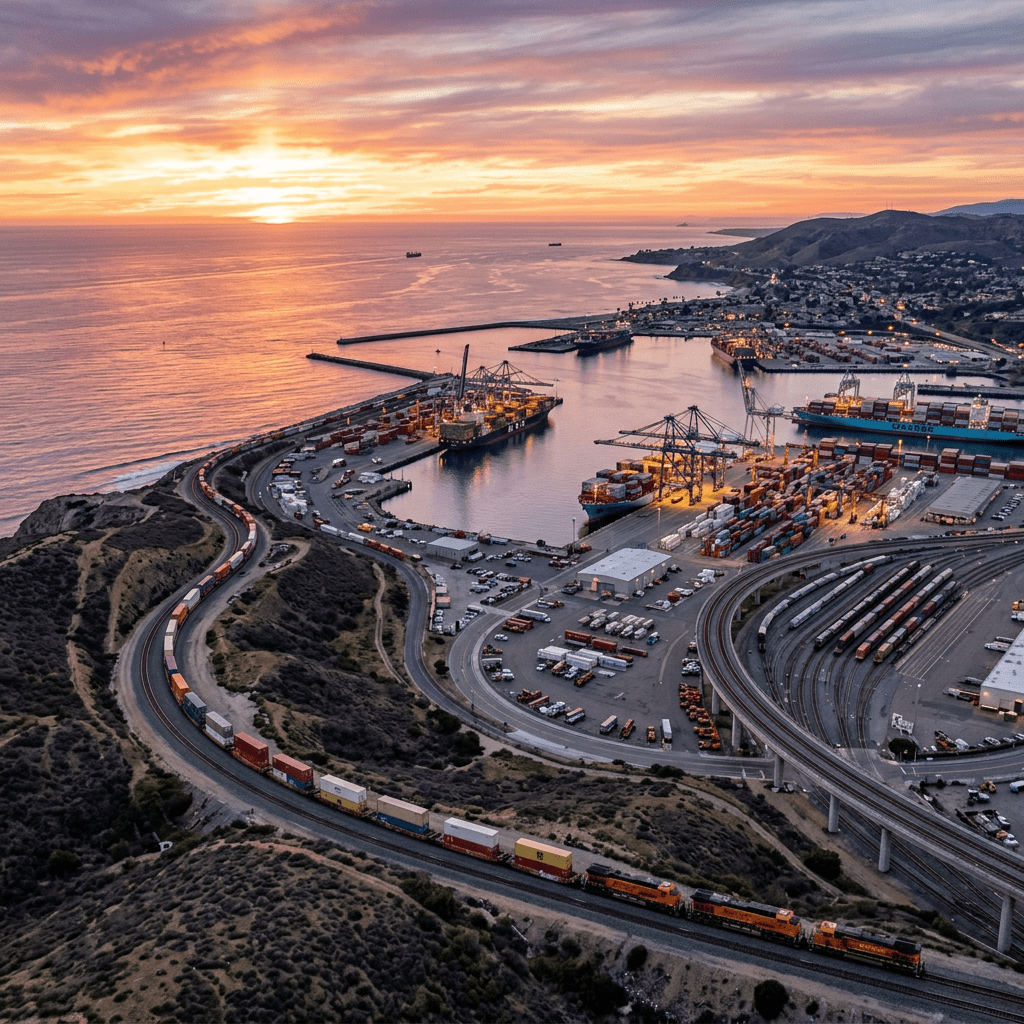
South Africa’s mining industry contributes approximately 7.3% to national GDP and directly employs over 460,000 people. Yet the country consistently exports well below its potential — not because of a lack of minerals, but because of bottlenecks along the logistics chain between pit and port. Understanding how these corridors work, which ones exist, and what challenges they face is essential for any business operating in or supplying the South African mining supply chain.
What Are Mine to Port Logistics Corridors?
A mine to port logistics corridor is an integrated transport route — combining road, rail, and port infrastructure — that moves raw minerals from extraction sites directly to export terminals. In South Africa, these corridors are the economic arteries of the mining sector, connecting some of the world’s richest mineral deposits to global commodity markets.
Why Mine to Port Corridors Matter
Every tonne of coal, iron ore, manganese, chrome, or platinum that leaves South Africa must travel a defined route from mine to terminal. The efficiency of that journey directly determines:
- Export competitiveness — slower corridors raise the landed cost of South African minerals on global markets
- Mining profitability — demurrage, delays, and detours erode margins at every step of the supply chain
- Investor confidence — unreliable logistics corridors deter capital investment in new mining projects
- Foreign exchange earnings — mineral exports are a primary source of South Africa’s hard currency revenue
Integrated partnerships across the value chain — linking mines, transport operators, and ports — are essential for optimising routes, improving scheduling, and reducing bottlenecks. When those links break, the consequences ripple across the entire economy.
South Africa’s Major Mine to Port Logistics Corridors
1. The Iron Ore and Manganese Corridor — Northern Cape to Saldanha Bay
This is arguably South Africa’s most strategically important dedicated mineral export corridor. Iron ore is extracted from the vast deposits around Sishen and Postmasburg in the Northern Cape, then transported along a dedicated 861-kilometre heavy-haul rail line to the Port of Saldanha Bay on the West Coast.
The same corridor also handles manganese exports, with ore moving from mines between Hotazel and Postmasburg to Saldanha Bay, and to the ports of Port Elizabeth and Ngqura in Nelson Mandela Bay — the latter forming the Nelson Mandela Bay Corridor, primarily for manganese exports. Saldanha Bay is South Africa’s deepest natural harbour and the only port purpose-built for bulk mineral exports, making it a critical node in the global iron ore supply chain.
Key commodities: Iron ore, manganese Ports: Port of Saldanha Bay, Port of Ngqura, Port Elizabeth Rail operator: Transnet Freight Rail (dedicated ore line)
2. The Coal Export Corridor — Mpumalanga to Richards Bay
The Richards Bay Coal Terminal (RBCT) is one of the world’s largest coal export terminals, and its supply is the coal export line running from the collieries of Mpumalanga through to the KwaZulu-Natal coast. Historically handling over 90 million tonnes per year at peak, this corridor is central to South Africa’s thermal and coking coal export earnings.
In recent years, underperformance on this line has cost South Africa billions in lost export revenue. At Richards Bay, the Bayvue precinct also handles non-RBCT coal, chrome, and magnetite through the Dry Bulk and Multi-Purpose Terminals — highlighting how the corridor serves multiple commodity streams simultaneously.
Key commodities: Thermal coal, coking coal, chrome, magnetite Port: Richards Bay Rail operator: Transnet Freight Rail (coal line)
3. The General Freight Corridor — Gauteng to Durban
The N3 corridor connecting Gauteng to Durban’s port is South Africa’s busiest multimodal freight route. While it serves all industries, it is critical for mining in terms of inputs (equipment, consumables, reagents) flowing to mines and for processed mineral products leaving through the Port of Durban. Gauteng, which accounts for 34% of national GDP, generates enormous freight volumes along this route.
Road transport currently dominates, carrying approximately 50.76% of South Africa’s total freight volumes. But this over-reliance on road results in congestion, infrastructure wear, and rising costs — particularly as fuel levies increase logistics expenses. The corridor is central to ongoing debates about modal shift and rail revival.
Key commodities: General mining inputs, containerised mineral products, bulk freight Port: Port of Durban Primary mode: Road (N3 highway), with rail component via Transnet Freight Rail
4. The Chrome and Platinum Corridor — Bushveld Complex to Multiple Ports
The Bushveld Complex in Limpopo and North West is home to the world’s largest known reserves of platinum group metals (PGMs) and significant chrome deposits. Logistics from this region are more complex, relying on a combination of road haulage and rail freight to reach ports including Durban, Richards Bay, and Cape Town depending on the destination market and commodity.
PGMs generated R28 billion in royalties in South Africa in 2024 alone. Yet the logistics chain serving these mines faces chronic challenges including cable theft, rail underperformance, and route unreliability.
Key commodities: Platinum, palladium, rhodium, chrome concentrate Ports: Durban, Richards Bay, Cape Town Primary mode: Mixed road and rail
The State of Mine to Port Rail Infrastructure
Rail is the backbone of every efficient mine to port corridor — cheaper per tonne-kilometre than road, lower in carbon emissions, and capable of moving bulk volumes that trucks simply cannot replicate at scale. Yet South Africa’s freight rail network has been in sustained decline.
Peak rail freight demand was reached in 2017 at 226.3 million tonnes. By 2022, volumes had fallen 34% to a historic low of 149.5 million tonnes. This collapse resulted from deteriorating network performance caused by delays, poor maintenance, equipment shortages, cable theft, and infrastructure vandalism. In 2024 alone, strategic rail corridors experienced 347 instances of vandalism, disrupting mineral transport and costing the mining sector an estimated R7.3 billion through cable theft.
Transnet, the state-owned rail and port operator, has struggled to recover lost performance. In response, South Africa is now pursuing rail liberalisation — opening the network to private operators for the first time in the country’s history.
In August 2025, the Ministry of Transport announced eleven private operators (out of 25 applicants) had been pre-selected to access 41 routes across six key rail corridors. These corridors cover the transport of both bulk and containerised freight including coal, iron ore, chromium, manganese, sugar, and fuel. The new operators will sign access agreements with Transnet for periods ranging from one to ten years. Among them are logistics company Grindrod and mining groups such as Menar, seeking to secure reliable transport for their production.
If private rail operators can restore reliability and increase capacity, South Africa’s mine to port corridors could unlock an estimated R45 billion in annual additional export potential, according to Minerals Council projections.
Key Challenges Facing Mine to Port Logistics Corridors
Infrastructure Deterioration and Maintenance Backlogs
Years of underinvestment have left rail lines, rolling stock, and port equipment in varying states of disrepair. Transnet’s capital expenditure consistently fell short of requirements, creating a compounding maintenance backlog that private investment alone will take years to address.
Cable Theft and Vandalism
Cable theft is perhaps the single most disruptive threat to rail corridor reliability in South Africa. Beyond the direct cost to the mining sector, it forces cargo onto roads, increases congestion, and accelerates road surface deterioration in mining regions. The 347 recorded vandalism incidents on strategic rail corridors in 2024 illustrate the scale of the problem.
Port Congestion and Connectivity
Despite reduced congestion at the Port of Durban in recent years, the UNCTAD Port Liner Shipping Connectivity Index for South Africa dropped to 99.27 in Q4 2024, indicating that connectivity and capacity challenges persist. Vessel turnaround times, crane productivity, and terminal throughput all remain areas requiring urgent improvement.
Over-Reliance on Road Haulage
When rail fails, road absorbs the overflow — but at significant cost. Road transport is three to five times more expensive per tonne-kilometre for bulk commodities, generates higher carbon emissions, and causes accelerated road wear in mining regions. As carbon border levies from key export markets tighten, the pressure to shift back to rail will only intensify.
Pace of Regulatory and Structural Reform
The National Logistics Crisis Committee (NLCC) has developed a Freight Logistics Roadmap covering five key trade corridors. However, implementation has been criticised for lacking clear performance milestones and binding deadlines. The pace of reform must accelerate significantly if South Africa is to reclaim its position as a reliable and competitive mineral exporter.
What Effective Mine to Port Logistics Looks Like
The best-performing mine to port corridors share common characteristics that mining companies and logistics partners should look for when evaluating routes and service providers:
- Integrated value chain partnerships — linking mine operations, transport providers, and port terminals into a single coordinated system rather than treating each as a separate silo
- Real-time monitoring and visibility — 24/7 control centres, GPS tracking, and logistics management systems that identify disruptions before they cascade into costly delays
- Route diversification — access to multiple port options and the ability to switch between road and rail provides critical resilience when primary channels are disrupted
- Long-term service agreements — structured contracts between mines and logistics providers that provide scheduling predictability and volume commitments, reducing uncertainty
- Active security protocols — anti-theft and anti-vandalism measures along rail routes, particularly on high-risk sections in KwaZulu-Natal, Limpopo, and the Northern Cape
The Outlook: Reform, Investment, and Opportunity
South Africa’s freight market is projected to grow at a CAGR of 3.64% between 2025 and 2030, supported by policy reforms, logistics modernisation, and regional integration through the African Continental Free Trade Area (AfCFTA). For mine to port corridors specifically, the trajectory is cautiously optimistic.
The government’s R132 billion infrastructure spending allocation over 2025–2027 includes targeted investment in transport corridors serving mining regions. Rail liberalisation, private terminal operations at ports, and Operation Vulindlela’s structural reform programme are all creating conditions for corridor performance to improve.
Dedicated corridor teams working on key mineral export routes have already reduced train turnaround times by 18%. The ICTSI concession at Durban Container Terminal Pier 2, while still being finalised, signals a broader shift toward private sector participation in port operations — a model that has delivered results in comparable markets globally.
For mining companies, logistics providers, equipment suppliers, and investors, South Africa’s mine to port logistics corridors are entering a period of significant restructuring. The structural constraints are real and well-documented, but so is the mineral wealth waiting to move. Those who understand the corridor landscape and engage with the reform process now will be well-positioned to benefit as reliability improves and export capacity expands.


Leave a Reply